
The Anatomy of Blame: Scapegoating and the Challenge to Myanmar’s Unity
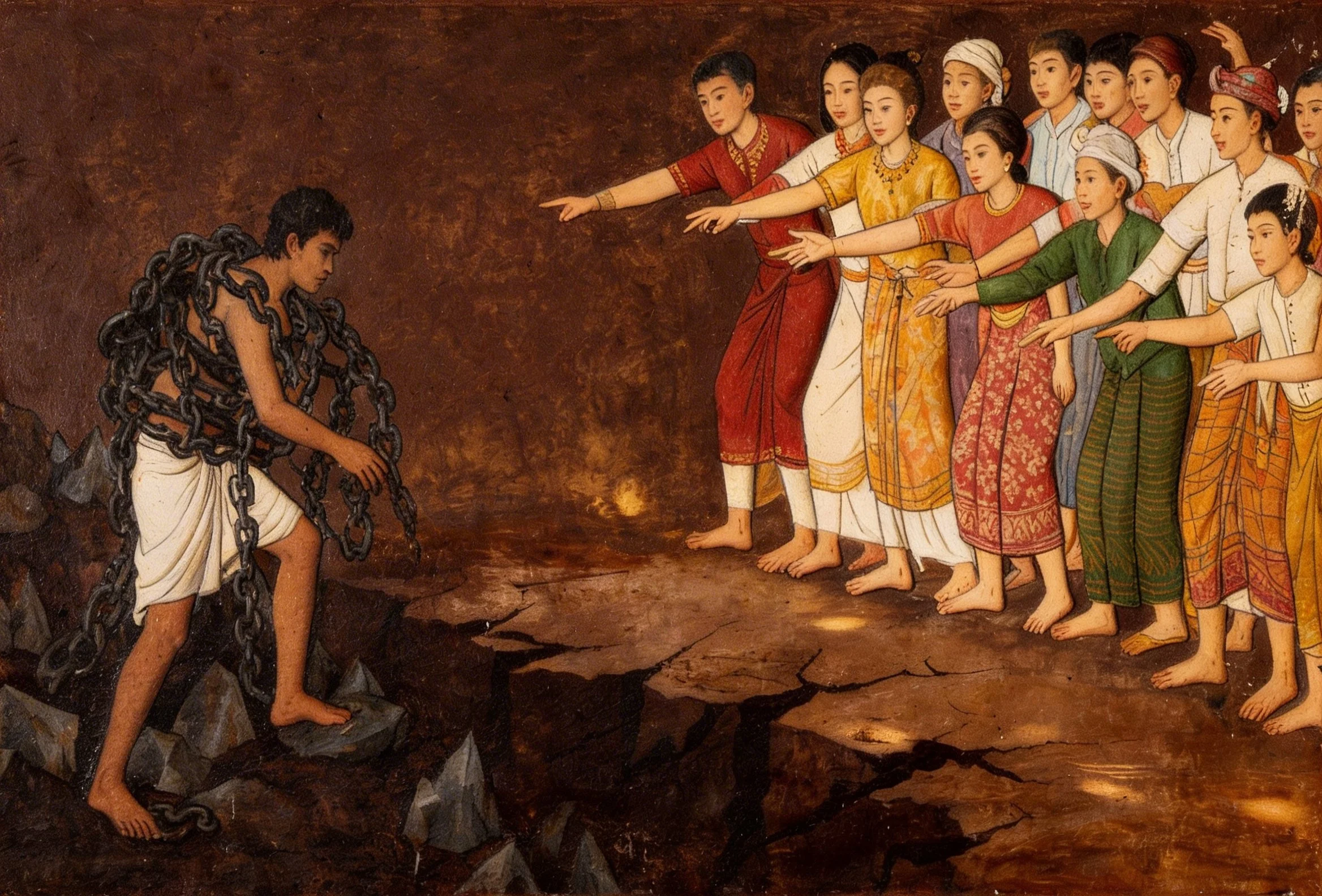
Visual generated by AI for illustrative purposes.
In the complex landscape of Myanmar’s ongoing struggle for democracy, the erosion of trust often stems from a deeply rooted psychological and social phenomenon: scapegoating. By unfairly projecting collective frustration and failures onto vulnerable groups or "safer" political targets, individuals and organizations often find a temporary reprieve from stress at the heavy cost of accountability and truth.
From its ancient historical origins to its manifestation in modern Myanmar pro-democracy discourse, this practice serves as a "psychological defense mechanism" that risks undermining the very cohesion required for a successful revolution. This article explores the delicate balance between legitimate political criticism and the destructive cycle of scapegoating. By analyzing how "displaced accountability" weakens alliances among anti-dictatorship forces, the author examines the urgent need for a transition from habitual blaming to a factual, forward-looking dialogue essential for building a unified federal future.
Understanding from a Social Psychology Perspective
According to the American Psychological Association (APA), scapegoating is defined as a process in which an individual “projects their anger, frustration, and aggression onto others, targeting them as the source of their problems and misfortunes.” This functions as a Psychological Defense Mechanism, allowing individuals to avoid responsibility for their own actions or flaws by shifting the burden onto someone else.
Historical Origins of the Term
The term “Scapegoating” has fascinating historical roots. It originates from an ancient Hebrew religious ritual described in Leviticus 16 of the Old Testament regarding the Day of Atonement (Yom Kippur). In this ceremony, two goats were selected: the first was sacrificed, while the second—the “scapegoat”—had the sins of the entire community symbolically placed upon its head by the High Priest. This goat, burdened with the community’s transgressions, was then sent away into the wilderness. Understanding these origins helps illustrate how deeply rooted the practice of shifting blame is within human culture and history.
Practical Examples in Daily Life
Consider a common scenario in our surroundings:
Parents pick up their children from school and, upon returning home, forget to lock the car. Later, someone steals a wallet from the unlocked vehicle. Instead of admitting their negligence, the parents blame the children, claiming they were distracted by them and thus forgot to lock the door.
This is a classic example of scapegoating. In reality, the parents are transferring responsibility to the children to avoid facing their own mistake. In Myanmar social life, this habit is so prevalent that it has manifested in common idioms such as “In the end, it’s just the thin one (who gets blamed)” (referring to the vulnerable being targeted).
Scapegoating is a behavior frequently observed when problems become complex; people seek the easiest explanations and tend to cast blame on the weak. The Myanmar proverb, “The prawn’s head is stuffed with the filth of every fish,” closely parallels the psychological concept of scapegoating.
The Myanmar Context
In Myanmar society, where signs of eroded trust are evident due to decades of political instability and ethnic conflict, scapegoating is a subject worthy of serious reflection.
Regarding the situation in Myanmar, most research on scapegoating has focused on anti-Muslim sentiment and the oppression of minorities. However, it is increasingly argued that we should also begin examining potential instances of scapegoating within the pro-democracy forces themselves.
Historically, the military in Myanmar has been an institution with immense control over political, economic, and social systems. However, because directly criticizing such a powerful and dangerous entity can be risky, some discourse shifts toward “safer” targets—political parties, specific individuals, or ethnic groups.
As the Spring Revolution persists, these instances are seen more frequently. Through the lens of scapegoating theory, this can be understood as “displaced accountability”—arising from power imbalances, fear, and a lack of cohesion between organizations.
According to this theory, a key characteristic of scapegoating is “diverting attention away from those fundamentally responsible for events and shifting the blame onto weaker groups.”
Example: Following the February 1, 2021 military coup and throughout the Spring Revolution, some criticisms directed at the ousted NLD or the Bamar majority—framed around “Chauvinism”—appear to have crossed the line from fair political critique into excessive scapegoating.
Conversely, we must recognize that criticizing political organizations is a necessary process for democracy. Therefore, it is vital to distinguish between legitimate criticism and scapegoating.
Furthermore, these scapegoating dynamics can damage trust-building and cooperation among anti-dictatorship forces. If partner organizations blame one another, cooperation weakens and unity is undermined. To achieve successful political change, it is essential to correctly identify the primary sources of power and remain grounded in reality. When blame and assessments of right and wrong lack a foundation in facts and theoretical consistency, they lead to both conceptual errors and practical weaknesses.
Conclusion
The point to emphasize is that not all criticism of the NLD or various ethnic groups should be labeled as scapegoating. The intent is to highlight the importance of distinguishing between justified criticism (e.g., policy failures, organizational flaws) and scapegoating (excessive blaming, shifting responsibility).
Therefore, when studying scapegoating, we must consider not only its impact on minorities in Myanmar but also its occurrence within democratic institutions. At a time when trust and unity are desperately needed, the urgent task is to avoid scapegoating and to promote pragmatic, forward-looking dialogue grounded in factual truth.
