
Misaligned Priorities and Sacrifices
A Strategic Analysis of Internal Division in Myanmar’s Spring Revolution
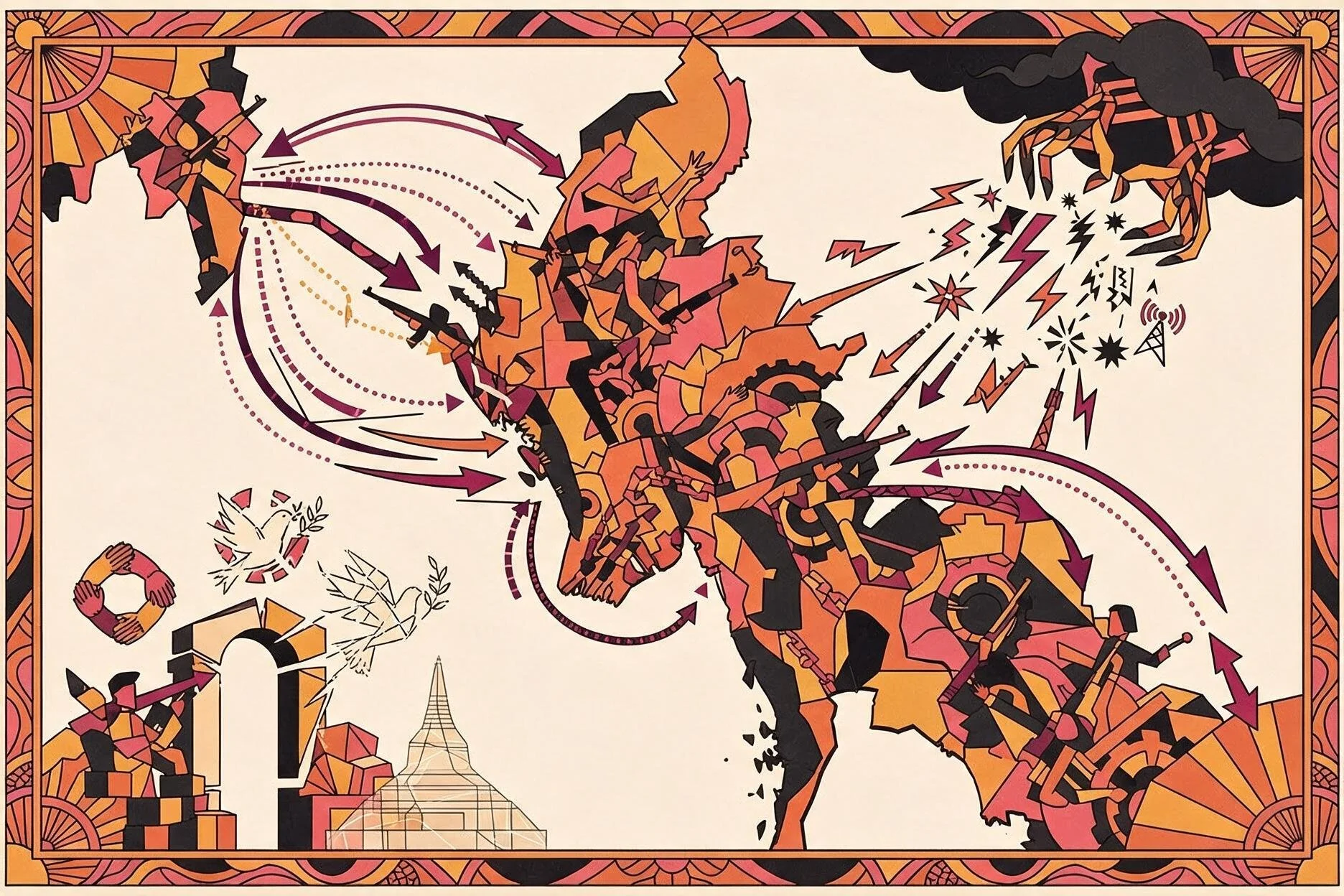
Visual generated by AI for illustrative purposes.
Key Takeaways
Strategic Vulnerability: Internal rivalries, territorial disputes, and power struggles among revolutionary groups pose a threat to the core objectives of the Spring Revolution.
Regime Exploitation: The military actively weaponises these divisions using psychological operations, disinformation, and informant networks to incite inter-factional conflict.
Strained Mandate: Authoritarian behaviours—such as suppressing criticism or prioritising factional dominance—breach the public’s trust and social contract.
Democratic Imperative: Long-term success requires practising democratic governance and institutional conflict resolution during the conflict phase, ensuring new authoritarian structures do not replace the old regime.
Estimated Reading Time: 3-4 minutes
1. Introduction: The Fragmented Resistance Landscape
Myanmar’s contemporary resistance landscape comprises a dynamic network of Ethnic Armed Organisations (EAOs), People’s Defence Forces (PDFs), political coalitions, and civil society movements. While this diversity reflects the broad-based rejection of the 2021 military coup, it also presents significant structural challenges. Differing political ideologies, administrative visions, and resource distribution strategies have given rise to inter-group friction, territorial competition, and political divergence.
In any anti-authoritarian movement, strategic cohesion requires a shared consensus regarding the primary adversary and the terminal political objective. While the total dismantling of the military dictatorship remains the stated goal across factions, operational reality often reveals deepening mutual suspicion, power struggles, and localised hegemony. When resistance forces divert political and military capital toward internal dispute resolution, the strategic momentum of the revolution is fundamentally compromised, creating profound disillusionment among the supporting populace.
2. Exploitation of Division: The Regime’s Counter-Insurgency Strategy
Internal fragmentation within resistance movements does not occur in a vacuum; it is actively weaponised by the ruling regime. For the Myanmar military, disunity among anti-regime forces represents a primary strategic advantage.
To capitalize on existing fault lines, the military systematically employs classic counterinsurgency tactics, including:
Information Warfare & Disinformation: Deploying fabricated news and digital propaganda to incite inter-ethnic and inter-factional animosity.
Infiltration & Intelligence Operations: Utilising networks of informants and operatives to sow distrust within local command structures.
Socio-Political Manipulation: Exploiting local grievances regarding territorial governance and resource allocation to trigger conflict among revolutionary sub-groups.
By heightening mutual paranoia, the regime effectively lowers the operational cost of its own defence. Falling into these calculated strategic traps shifts the resistance’s focus away from regime targets and toward internal conflict, serving the regime's ultimate goal of survival through division.
3. The Livelihood Crisis and the Popular Mandate
The sustainability of the Spring Revolution rests almost entirely on public support. Citizens across Myanmar continue to endure severe economic hardship, displacement, and security risks to sustain resistance forces through financial donations, logistical supply chains, intelligence sharing, and direct service.
This public support is contingent upon a clear social contract: the commitment of resistance forces to overthrow military authoritarianism and establish a democratic federal union. When revolutionary actors prioritise group-level dominance, territorial expansion, or political consolidation over collective victory, this social contract is strained. Revolutionary organisations must critically evaluate whether their actions align with public expectations or merely replicate the authoritarian behaviours they seek to eradicate—such as suppressing internal dissent, marginalising political rivals, and centralising power.
4. Re-centring Democratic Values in the Resistance Phase
A durable transition away from military rule requires that democratic values and institutional norms be practised during the revolution, rather than deferred to a post-conflict environment. Re-establishing strategic unity requires several institutional shifts:
Institutionalisation of Conflict Resolution Mechanisms: Establishing transparent dialogue channels among EAOs, the National Unity Government (NUG), and local defence forces to address territorial and administrative overlaps peacefully.
Counter-Disinformation Resilience: Building robust internal communication frameworks to mitigate the impact of regime-led psychological operations and cognitive warfare.
Focus on Post-Regime Governance: Shifting the strategic discourse from short-term power distribution to long-term democratic systems design, ensuring that new structures prevent the re-emergence of authoritarianism in any form.
5. Conclusion
The sacrifice of combatants and the resilience of the civilian population demand strategic discipline from resistance leadership. Defeating a consolidated military requires maintaining unwavering focus on the primary strategic target while actively resisting external manipulation and internal power struggles.
Ultimately, the measure of success for the Spring Revolution will not be defined merely by the collapse of the military dictatorship, but by the nature of the state that replaces it. To fulfil the aspirations of the public, Myanmar’s revolutionary forces must prioritise collective unity, democratic principles, and institutional trust over factional self-interest.
