
The Pattaya Meeting on Myanmar: Reviving the Five-Point Consensus—or Providing the Military Junta with a Political Lifeline?
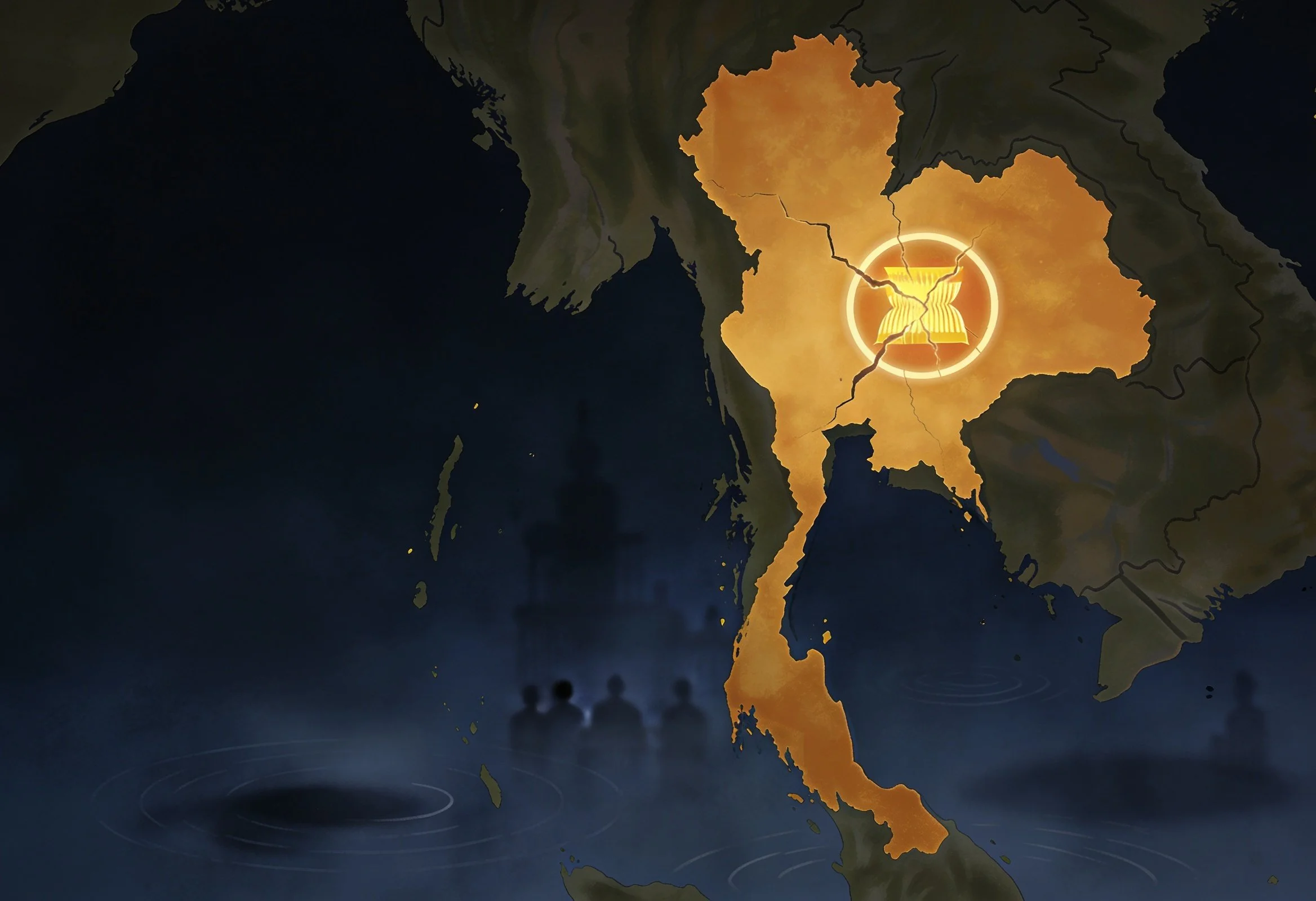
Visual generated by AI for illustrative purposes.
Key Takeaways
The informal Pattaya meeting risks granting Myanmar’s military junta political legitimacy rather than advancing ASEAN’s Five-Point Consensus (5PC).
Intersecting Agendas: The meeting reflects a convergence of Thailand’s border and economic interests, the junta's push for political normalisation, and legacy peace actors seeking institutional relevance.
Junta Strategy: The regime uses incremental engagement to signal international acceptance while failing to curb violence, release political prisoners, or allow humanitarian aid.
Unequal Engagement: Giving the junta ministerial-level access while limiting the National Unity Government and resistance forces to secondary roles reinforces the regime's legitimacy and divide-and-rule tactics.
Estimated Reading Time: 5-6 minutes
This week’s informal meeting in Pattaya between the ASEAN Chair’s Special Envoy, Thailand’s Foreign Minister, and representatives of Myanmar’s military junta will likely be viewed by many observers as another effort to advance the implementation of ASEAN’s Five-Point Consensus (5PC). Yet a closer examination of the interests at play, the objectives of the participants, and the potential political consequences reveals a far more complex picture.
The fundamental question is not whether the meeting should have taken place. Rather, it is whether such engagement is capable of changing the behaviour of Myanmar’s military junta—or whether it instead serves to provide the junta with a gradual pathway back into ASEAN’s political mainstream.
Viewed in its current context, the Pattaya meeting appears less a mechanism for exerting meaningful pressure on the junta to comply with the Five-Point Consensus than a platform where the interests of the Thai authorities, Myanmar’s military junta, and certain actors operating under the banner of “peace” intersect.
Thailand’s National Interests
For Thailand, the Myanmar crisis is approached less as a question of democracy and human rights than through the lens of national interests—energy security, border stability, cross-border trade, refugee management, and the commercial interests of Thai state-owned or state-linked enterprises.
Myanmar’s natural gas exports, electricity supply, and strategic economic corridors remain of tangible importance to Thailand. At the same time, armed conflict along the shared border, refugee movements, narcotics trafficking, human trafficking, and the proliferation of cyber scam operations have direct implications for Thailand’s national security.
It is therefore understandable that Thailand’s policy towards Myanmar places greater emphasis on safeguarding its border security and economic interests than on fundamentally altering the political behaviour of the military junta. Such prioritisation reflects legitimate national interests.
In truth, can these interests be secured simply by pressuring and coercing ethnic revolutionary organisations in the border areas to comply with the military junta's wishes, or by merely accommodating the junta? The Thai authorities need to realise that this is practically impossible.
The concern, however, arises when the bilateral interests shared by Thailand and the junta begin to shape, or are perceived as shaping, ASEAN policy itself. Unless a clear distinction is maintained between Thailand’s diplomacy as the host country and ASEAN’s collective position, there is a real risk that the Five-Point Consensus will gradually be displaced by an agenda centred on border stabilisation and economic normalisation.
For the Junta, Even Limited Engagement Is a Strategic Gain
For Myanmar’s military regime, the principal value of informal meetings such as the Pattaya gathering does not lie in reaching concrete agreements. The opportunity to be received and engaged is, in itself, a political dividend.
Although the military junta remains excluded from ASEAN’s high-level meetings and political representation, it has sought to gradually work its way back into ASEAN’s political orbit through informal dialogues, bilateral engagements, and participation in special initiatives. This reflects what is commonly known as the “camel’s nose under the tent” strategy: gaining an initial foothold through limited engagement before progressively expanding one’s presence and influence.
The progression is incremental: informal discussions become regional consultations; consultations evolve into meetings with ASEAN foreign ministers; and these, in turn, create a pathway towards eventual participation in ASEAN’s regular ministerial and leaders’ meetings.
At a minimum, the immediate objective is propagandistic. The junta is able to project, both domestically and internationally, the narrative that “ASEAN is engaging with us once again.” Reporting and narratives before and during the Pattaya meeting already illustrate how such perceptions can be cultivated.
Its longer-term objective is more significant: the gradual reconstruction of its political legitimacy.
More troubling still is the possibility that the junta may continue to reap the benefits of engagement without demonstrating any meaningful compliance with the Five-Point Consensus. Violence has not subsided. Political prisoners remain incarcerated. Humanitarian assistance continues to face obstruction. If, despite these realities, the junta continues to enjoy access to ASEAN foreign ministers, what incentive remains for it to comply with the Five-Point Consensus at all?
Peace Initiatives—or the Preservation of Peace Projects?
A third set of interests surrounding the Pattaya meeting relates to those seeking to revive the military junta’s National Ceasefire Agreement (NCA)-based “peace process”.
The junta has sought to portray consultations conducted through its own political mechanism—the National Solidarity and Peacemaking Negotiation Committee (NSPNC)—and with selected organisations operating within the NCA framework as evidence of an ongoing political dialogue. Yet Myanmar’s political landscape today bears little resemblance to that which existed when the Nationwide Ceasefire Agreement was signed in 2015.
The National Unity Government (NUG) has emerged as a significant political actor. Ethnic revolutionary organisations now exercise considerably greater territorial control than before. In mainland areas administered by resistance forces, local federal governance mechanisms have begun to take shape. New forms of collective political leadership, such as the Steering Council for the Emergence of a Federal Democratic Union (SCEF), have also emerged.
Against this backdrop, attempting to restore an NCA-only framework as the principal vehicle for resolving Myanmar’s political crisis amounts to overlooking the realities that have fundamentally reshaped the country’s political landscape.
Nevertheless, for some individuals and organisations that have long been involved in Myanmar’s peace industry, reviving the process offers opportunities to preserve project continuity, maintain funding streams, retain institutional relevance, and sustain mediation roles.
It is therefore legitimate to ask whether, behind the language of “peace”, some interests are more heavily invested in preserving long-standing projects than in advancing genuine conflict transformation.
Who Benefits from the Weakness of ASEAN’s Chairmanship?
If the current ASEAN Chair lacks a coherent strategy, measurable benchmarks, and decisive political leadership on Myanmar, the organisation’s collective process risks being overshadowed by the national agenda of individual member states.
In the case of the Pattaya meeting, Thailand appears to have successfully leveraged its position as host to align its own Myanmar policy with the broader ASEAN process.
At the same time, serious questions should be asked as to whether the ASEAN Chair’s Special Envoy has, intentionally or otherwise, become positioned between three intersecting agendas: Thailand’s national interests, the junta’s agenda of political normalisation, and the priorities of those seeking to revive legacy peace processes.
Should ASEAN allow the national interests of a single member state to become conflated with ASEAN’s collective position, the Five-Point Consensus may continue to exist as official policy while gradually losing its practical meaning.
Is Thailand Replicating China’s Border Stabilisation Model?
Thailand’s current approach bears notable similarities to the border stabilisation model employed by China in northern Myanmar.
Beijing has consistently approached Myanmar’s conflict primarily through the prism of border stability, trade corridors, investment protection, and preventing instability from spilling into Chinese territory, rather than through the lenses of democratic governance or human rights.
Thailand increasingly appears to be adopting a comparable, interest-driven approach to stabilisation along its own border.
Yet border stability and political conflict resolution are not synonymous.
Reducing hostilities in a particular area, reopening trade routes, or securing stable energy flows may contribute to short-term stability, but none of these measures necessarily alters the junta’s political objectives, its determination to retain power, or its continued reliance on coercion and violence as instruments of governance.
ASEAN Should Measure Outcomes—Not Engagement
As the National Unity Government has rightly observed in its statement, ASEAN should not measure success by the number of meetings convened, the number of visits undertaken by special envoys, or the number of diplomatic statements issued.
The relevant questions are far more substantive. Has the junta reduced its air strikes? Has violence against civilians diminished? Have political prisoners been released? Can humanitarian assistance now be delivered freely, without the interference of the junta? Has the ASEAN Special Envoy been granted unrestricted access to political prisoners, including Daw Aung San Suu Kyi? Are the National Unity Government, ethnic revolutionary organisations, SCEF, democratic forces, and civil society organisations being engaged on an equal footing with the military junta?
If the answer to these questions remains “not yet”, then the Pattaya meeting cannot credibly be described as a meaningful step towards implementing the Five-Point Consensus.
Unequal Engagement Risks Becoming Partiality
If Myanmar’s military junta is granted face-to-face access, ministerial-level engagement, and opportunities to present its narrative directly before ASEAN foreign ministers, while the National Unity Government (NUG) and other principal resistance actors are confined to virtual consultations, lower-level exchanges, or fragmented bilateral meetings, such an approach cannot reasonably be characterised as balanced engagement.
More importantly, it not only enables the junta to become the dominant sole narrator of Myanmar’s crisis, but also inadvertently reinforces its claim that “it alone represents the Myanmar state”.
Furthermore, if ASEAN engages the National Unity Government (NUG), ethnic revolutionary organisations, and emerging collective political leadership mechanisms such as the Steering Council for the Emergence of a Federal Democratic Union (SCEF) separately rather than encouraging coordinated political engagement, it risks reinforcing precisely the fragmentation upon which the junta’s long-standing strategy of divide-and-rule depends.
If ASEAN is genuinely committed to resolving Myanmar’s crisis, its objective should not be to engage stakeholders in isolation, but rather to support stronger mechanisms for collective dialogue and political coordination among Myanmar’s democratic and revolutionary forces.
Lessons from Myanmar’s History
The people of Myanmar have lived through generations of military rule characterised by broken promises, deliberate delays, divide-and-rule tactics, and the systematic exploitation of weaknesses within the international community.
The junta’s strategy is neither novel nor unfamiliar. When international pressure intensifies, it signals a willingness to engage in dialogue. Once engagement begins, it delays substantive progress. It isolates political actors from one another. It then presents informal diplomatic engagement as evidence of growing international acceptance.
Ultimately, while leaving its underlying behaviour unchanged, it seeks to convert diplomatic engagement into renewed political legitimacy.
If ASEAN and Myanmar’s neighbours believe that such a strategy can be transformed merely through continued engagement—without first learning from this history—they risk inflicting yet another profound disappointment upon the people of Myanmar.
The Real Test of Pattaya
The Pattaya meeting may well represent a diplomatic opening. The more important question, however, is for whom that door is being opened. Is it opening the way for the genuine implementation of the Five-Point Consensus? Is it opening the way for a reduction in violence and the delivery of humanitarian assistance? Is it opening the way for an inclusive political process involving all relevant stakeholders?
The answer will not be found in official photographs, carefully crafted diplomatic language, or meeting communiqués. It will be found in whether the junta’s behaviour changes.
If violence continues unabated, if political prisoners remain behind bars, if humanitarian access remains restricted, and if engagement expands only with the military junta while excluding an inclusive political process, then the Pattaya meeting cannot credibly be regarded as a step towards implementing the Five-Point Consensus.
Rather, it will come to be seen as a political convergence of three separate agendas: Thailand’s national interests, the junta’s agenda of political normalisation, and the project-driven priorities of certain actors operating under the banner of peace.
More troubling still, the history of Myanmar and that of ASEAN may ultimately judge it not as a policy designed to change the behaviour of Myanmar’s military junta, but as one that afforded them renewed political breathing space.
