
Trading One Patron for Another
The Perils of Naypyidaw’s Russian Gambit
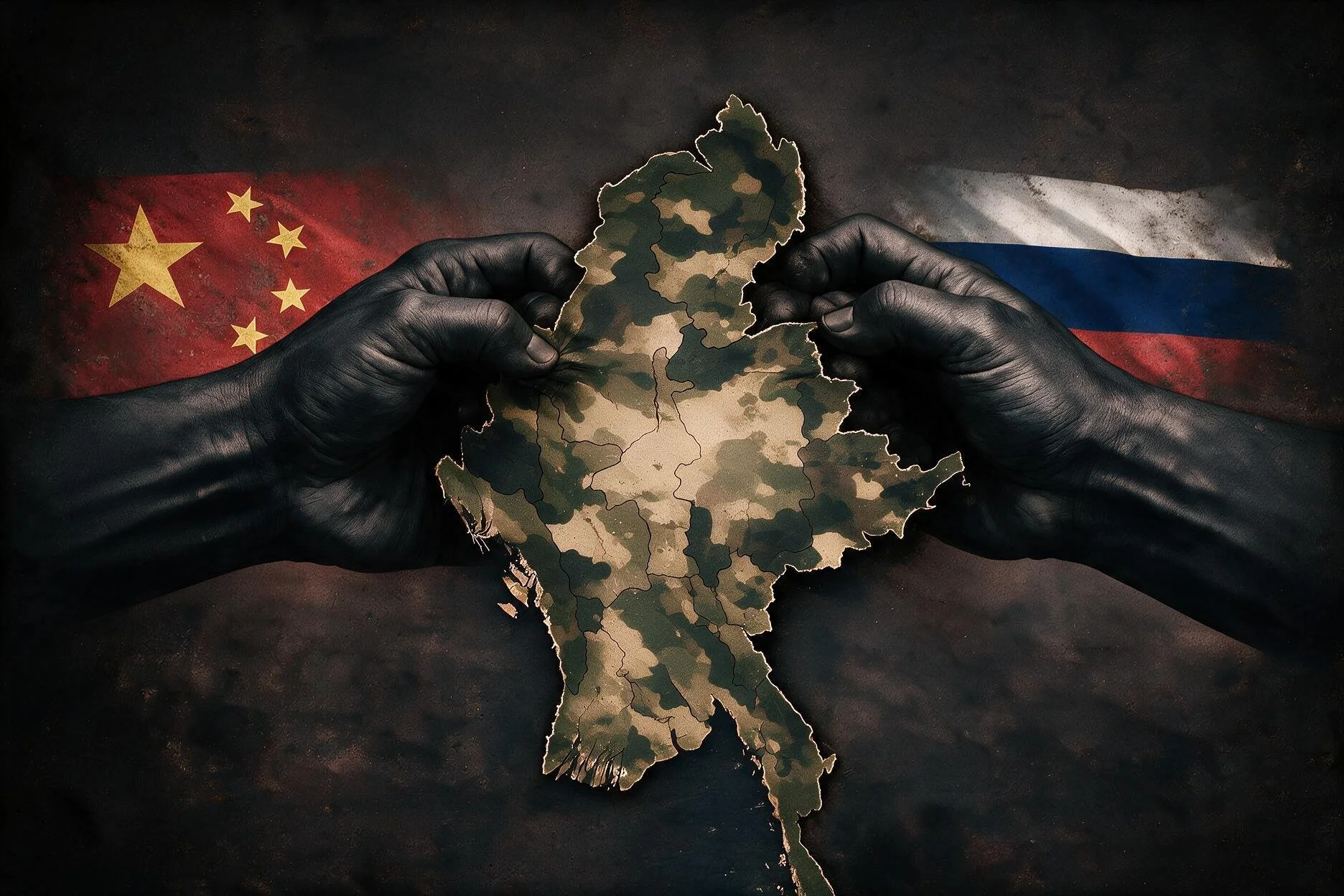
Visual generated by AI for illustrative purposes.
Key Takeaways
Hedging Against Beijing: Naypyidaw's deepening pivot to Moscow is driven by growing distrust of China following the battlefield losses of Operation 1027 in northern Shan State.
Costly Concessions in Dawei: To revive the stalled Dawei Special Economic Zone, the regime faces strict Russian demands for majority equity and operational control throughout the capital payback period.
Critical Sovereign Liabilities: Surrendering majority ownership over deep-sea port terminals, a 660 MW power plant, and an oil refinery severely limits local oversight along vital maritime corridors.
Structural Limitations: Geographically distant and sanctioned, Russia cannot match China's economic scale or border leverage, exposing Myanmar to secondary sanctions without securing true strategic autonomy.
Estimated Reading Time: 3-4 minutes
Following the orchestrated transition of the State Administration Council (SAC) into a nominal “civilian” government—with Senior General Min Aung Hlaing firmly at the helm as president—Naypyidaw has intensified its outward search for geopolitical lifelines. Confronted with persistent domestic armed resistance and international isolation, the military-led administration is actively courting Moscow. By dangling lucrative concessions in the oil, gas, and infrastructure sectors, the regime seeks not only diplomatic cover and military hardware, but also a counterweight to Beijing.
Yet, this pivot to Russia—a power geographically remote and burdened by its own international sanctions—carries significant strategic and sovereign risks for Myanmar. Rather than achieving strategic autonomy, the regime’s willingness to surrender majority control in critical infrastructure like the Dawei Special Economic Zone (SEZ) risks replacing asymmetric dependence on China with an unsustainable mortgage to Moscow.
The Shadow of Operation 1027 and the Beijing Dilemma
Naypyidaw’s urgency to diversify its external patrons stems directly from its fraught, distrustful relationship with China. For decades, Myanmar’s military establishment has harboured deep-seated anxieties over Beijing’s oversized economic footprint and strategic leverage. These tensions reached a boiling point following the launch of Operation 1027 in late 2023 by the Three Brotherhood Alliance.
The sweeping offensive dismantled military garrisons across northern Shan State, severed vital border trade corridors, and exposed the regime's operational vulnerabilities. In the eyes of the military leadership, the offensive succeeded only because Beijing provided tacit approval to eradicate border cyber-scam operations and arms support to the Three Brotherhood Alliance.
While China continues to engage the regime to safeguard its China-Myanmar Economic Corridor (CMEC) assets and Kyaukpyu deep-sea port aspirations, Naypyidaw no longer views Beijing as a reliable guarantor of its survival. Courting Russia is therefore an attempt to balance China’s influence and signal that Myanmar has alternative major-power alignments.
The Cost of Courting Moscow: The Dawei SEZ Concession
Unlike Beijing, Moscow brings no border disputes and few localised ethnic complications to the table. However, Russian engagement is far from philanthropic. As the regime attempts to revive the long-stalled Dawei Special Economic Zone (SEZ) in southern Tanintharyi Region, Moscow’s entry comes with stringent conditions.
Russian Economic Development Minister Maxim Reshetnikov affirmed during recent bilateral business forums that Russian investment—spanning a planned 660 MW power plant, a deep-sea port, and an oil refinery—is contingent on Russian companies securing majority ownership during the capital payback period.
| Key Project Dimension | Russian Demand / Proposed Scope | Strategic & Economic Implications for Myanmar |
|---|---|---|
| Equity & Governance | Majority stake ( >50% ) for Russian state-linked entities during payback. | Strips local authorities of operational oversight and sovereignty over strategic transport corridors. |
| Energy & Refining(CPI) | Development of 660 MW power plant and dedicated crude oil refining facilities. | Locks Myanmar’s energy grid into Russian supply chains and sanction-exposed financial mechanisms. |
| Maritime Access | Deep-water port access on the Andaman Sea / Indian Ocean. | Grants Moscow strategic maritime footholds, heightening regional geopolitical friction. |
Strategic Autonomy or Sovereign Liquidation?
The Dawei deep-sea port was originally conceived as a gateway linking Southeast Asia to the Indian Ocean and European markets. Ceding majority operational and equity stakes to Moscow during an extended recovery period compromises long-term national sovereignty.
Vulnerability to Secondary Sanctions: Deeply entangling Myanmar’s vital trade and energy corridors with state-backed Russian conglomerates leaves the national economy exposed to Western secondary sanctions and capital flight.
Limited Counterweight Value: Russia cannot replace China as a proximate trade partner or border stabilizer. Moscow lacks the regional logistics, geographic contiguity, and financial liquidity to act as a genuine hedge against Beijing’s economic gravity.
Escalating Domestic Discontent: Alienating sovereign national assets to foreign powers under opaque terms further damages what remains of the regime's domestic credibility and stokes local resistance in resource-rich coastal regions.
Conclusion
Naypyidaw’s diplomatic posture illustrates the perils facing an isolated regime attempting to secure external legitimacy. In attempting to counterbalance Beijing’s leverage after the battlefield shocks of Operation 1027, the military-controlled government is ceding control of key national assets to Moscow. Demanding majority ownership in Dawei exposes the transaction for what it is: an asymmetric deal where long-term sovereign economic infrastructure is traded for immediate political survival.
