
Thailand’s Border Dilemma Between Energy Dependencies and Frontier Entanglement
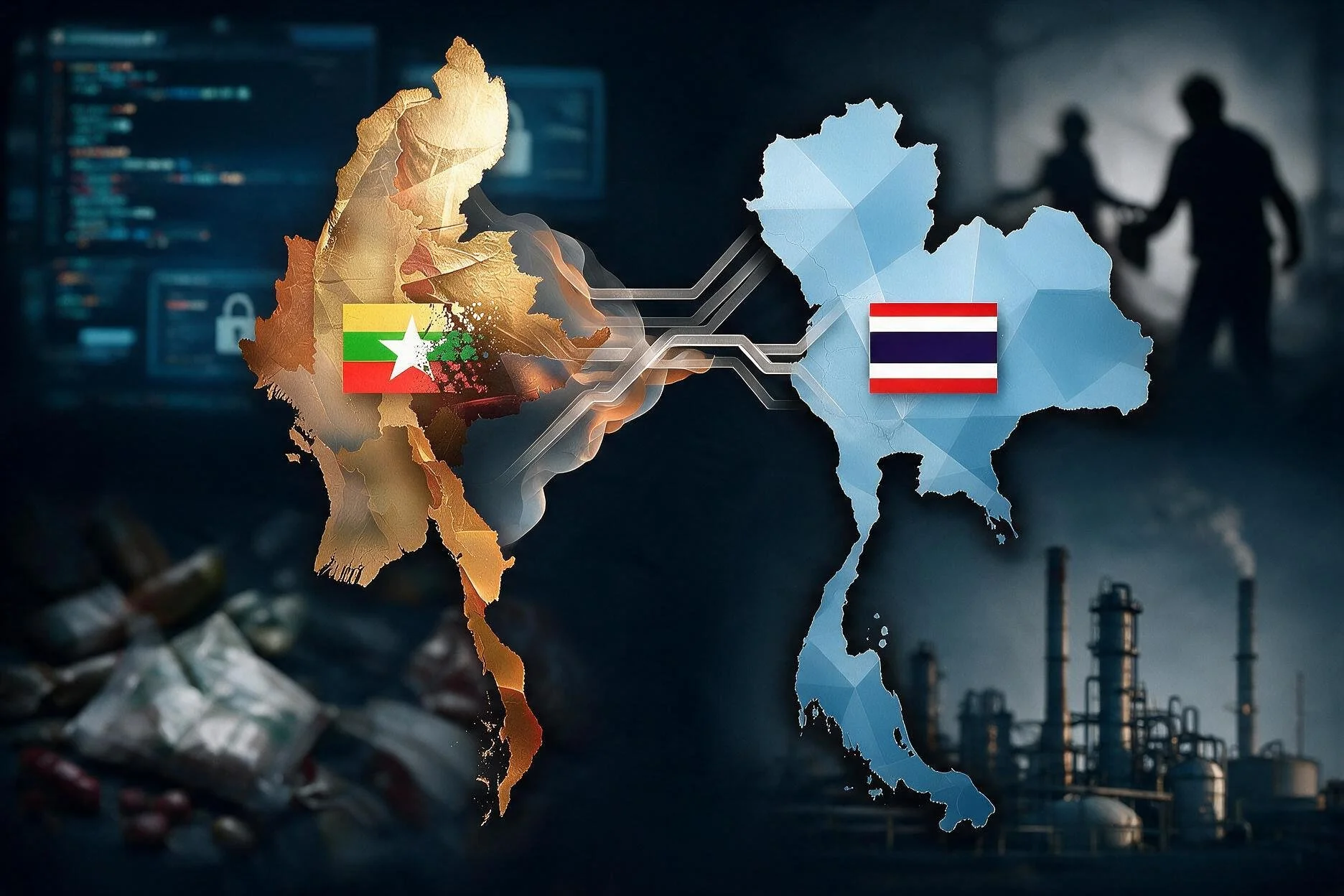
Visual generated by AI for illustrative purposes.
Executive Summary
High-level defence engagements between Bangkok and Naypyidaw highlight the tightening strategic bind governing Thailand’s Myanmar policy. Following talks between Myanmar’s newly appointed Commander-in-Chief, General Ye Win Oo, and Thai defence leadership, Naypyidaw has intensified pressure on Bangkok to interdict supply routes and arms smuggling feeding pro-democracy resistance forces across Karen State, Kayah State, and Tanintharyi Region.
While framed by Naypyidaw as mutual border stabilisation, Bangkok faces a high-stakes balancing act. Thailand’s domestic energy grid remains anchored to offshore Myanmar natural gas, billions of baht circulate through formal and informal frontier trade, and ethnic armed organisations (EAOs) alongside resistance forces hold functional ground control across critical transit and energy corridors. Acceding narrowly to the junta’s security requests risks alienating border actors holding leverage over Thai infrastructure, while leaving unaddressed the illicit networks—from cyber-scam compounds to narcotics—that pose the most immediate threat to Thai sovereignty.
Estimated Reading Time: 5 minutes
The Economic & Energy Underpinnings of Thailand's Exposure
Bangkok's strategic posture cannot be analysed in isolation from its structural resource dependencies.
| THAILAND'S STRATEGIC EXPOSURE | |
|---|---|
| ENERGY SECURITY | FRONTIER ECONOMICS & SECURITY |
| 10-15% of Thai power gen relies on Myanmar offshore gas | Vital bilateral border trade hubs (Mae Sot, Myawaddy, Ranong) |
| PTTEP operates Yadana (M5/M6) & Zawtika (M9) via Kanbauk line | Pipeline corridors traverse territory influenced by anti-junta resistance |
| Block M9 "Min Ye Thu" discovery critical for pipeline longevity | Transnational scam cities & BGF compounds operate directly along the Thai perimeter. |
Gas Dependency & PTTEP Operations: Thailand relies on natural gas for roughly 55–60% of its electricity generation mix, with offshore imports from Myanmar (the Yadana and Zawtika fields) historically contributing 10% to 15% of national power supply. Following the withdrawal of Western majors like TotalEnergies and Chevron, Thailand’s state-backed PTTEP assumed operatorship of Yadana (Block M5/M6) and continues to operate Zawtika (Block M9).
The Kanbauk–Nat-Ein-Taung Vulnerability: Pipeline flows route onshore via the Kanbauk receiving terminal in Yebyu Township, Tanintharyi Region, crossing through Nat-Ein-Taung into Kanchanaburi Province, Thailand. The entire overland corridor passes through operational zones contested or heavily influenced by resistance formations (including the Karen National Liberation Army’s 4th Brigade, PDF battalions under the Southern Combat Command / Military Region 2, and local defence networks). Any overt move by Thailand to actively suppress resistance lines could make this vital energy conduit a target for kinetic disruption, threatening immediate blackouts across western Thailand and Bangkok.
Satellite Tie-ins: PTTEP's discovery of the Min Ye Thu satellite reservoir within Block M9 (yielding ~21 MMSCFD across a 31-meter gas pay zone) is engineered to prolong the lifespan of the depleting Zawtika infrastructure. Preserving operational continuity requires stability across both sides of the maritime and terrestrial border.
Naypyidaw’s Counter-Offensive Strategy: Shifting the Interdiction Burden
Faced with severe manpower constraints and sustained multi-front offensives along its eastern frontier, Naypyidaw is attempting to leverage bilateral state-to-state mechanisms to starve resistance forces of materiel.
| Bilateral Interaction | Key Actors Involved | Naypyidaw's Core Demand | Strategic Objective |
|---|---|---|---|
| High-Level Officials Meeting | Gen. Ye Win Oo & Gen. Udomrit Boontanont | Strict interdiction of arms, drones, and materiel transit. | Choke off southern resistance operational supply lines. |
| Executive Consultations | Min Aung Hlaing & Thai Prime Minister | Joint border control & diplomatic normalization. | Neutralise border rear bases and regain frontier logistics control. |
For Myanmar’s military leadership, shifting the interdiction burden onto Thai security forces accomplishes two operational goals:
It creates friction between Thai law enforcement and Myanmar resistance groups operating logistical networks in border transit hubs like Mae Sot.
It attempts to project an image of normalisation and operational partnership with ASEAN's frontline state following the post-March 2026 administrative leadership transitions.
The Asymmetry of the Security Agenda: The Transnational Crime Blind Spot
The central flaw in Naypyidaw's proposed security framework is its deliberate selectivity. While Myanmar’s military leadership demands vigorous enforcement against arms smuggling, it offers minimal systemic cooperation on the transnational criminal threats inflicting immediate harm on Thai citizens:
| THE TRANSNATIONAL THREAT MATRIX | |
|---|---|
| THREAT VECTOR | OPERATIONAL ENVIRONMENT & LOCAL POWER ALIGNMENT |
| Industrial Cyber Scams ("Pig Butchering") | Heavily entrenched in autonomous enclaves (e.g., Shwe Kokko, KK Park, Kyaukkhet) run by Border Guard Forces (BGF) aligned with Naypyidaw. |
| Human Trafficking | Thousands of foreign & Thai nationals funnelled across border checkpoints into forced-labour hubs. |
| Narcotics & Precursors | Record flows of synthetic methamphetamine and yaba transiting porous border corridors into Thailand. |
By focusing almost exclusively on weapons interdiction, Bangkok risks playing directly into Naypyidaw’s counter-insurgency objectives while leaving the lucrative illicit economies funding junta-aligned militias completely intact.
Strategic Roadmap: Principles for Thai Policy Calibration
To navigate this dilemma without compromising its economic interests or international legitimacy, Thailand must pursue a synchronised three-pillar border strategy:
| CALIBRATED THAI BORDER POLICY | ||
|---|---|---|
| 1. SECURITY & LAW ENFORCEMENT | 2. BALANCED DIPLOMACY & HEDGING | 3. HUMANITARIAN & ECONOMIC SECURITY |
| Neutralise transit of weapons under sovereign Thai law. | Preserve direct channels with EAOs and resistance. | Establish safe civilian protection buffer zones. |
| Tie cooperation to the eradication of scam centers & BGFs. | Avoid joint kinetic operations that signify alignment. | Coordinate structured aid with INGOs/UN agencies. |
| Insulate critical energy infrastructure (Kanbauk). | ||
Reframe Enforcement as Sovereign Law, Not Regime Collaboration: Interdictions of weapons, drones, and unlicensed materiel must be strictly executed and publicly communicated as sovereign Thai domestic law enforcement. Bangkok must avoid joint operational optics that frame Thai authorities as an auxiliary policing arm for the Myanmar military.
Condition Bilateral Engagement on Transnational Crime: Thai negotiators must refuse single-issue agendas. Any security dialogue regarding border control must be explicitly tied to concrete, verifiable actions against BGF-backed cyber-scam cities, illegal border casinos, human trafficking rings, and synthetic drug corridors.
Maintain Pragmatic Multi-Stakeholder Hedging: Thailand's physical border is de facto governed by non-state actors, ethnic armies, and local administration units. Severing ties with resistance stakeholders would destabilize border trade, jeopardize pipeline security in Tanintharyi, and blind Thai intelligence along hundreds of kilometers of shared frontier.
Institutionalize Humanitarian Buffer Systems: Rather than reactive camp closures or ad-hoc pushbacks during military airstrikes, Thailand should formalize humanitarian coordination protocols with international agencies, establishing designated border reception zones that mitigate local economic stress and burnish Bangkok's international standing.
Analytical Conclusion
Thailand cannot afford a zero-sum policy on Myanmar. Acceding uncritically to Naypyidaw’s border interdiction demands would expose Thailand's vital energy lifelines to guerrilla retaliation, entrench criminal empires operating along its perimeter, and incur severe reputational costs.
A sustainable Thai posture must treat border governance not as a political concession to Naypyidaw, but as a comprehensive strategy designed to protect Thai citizens, insulate national energy infrastructure, and preserve the flexibility required to engage whichever actors genuinely control the frontier.
