
The Political Gravity: Finding Political Order in a Multipolar World
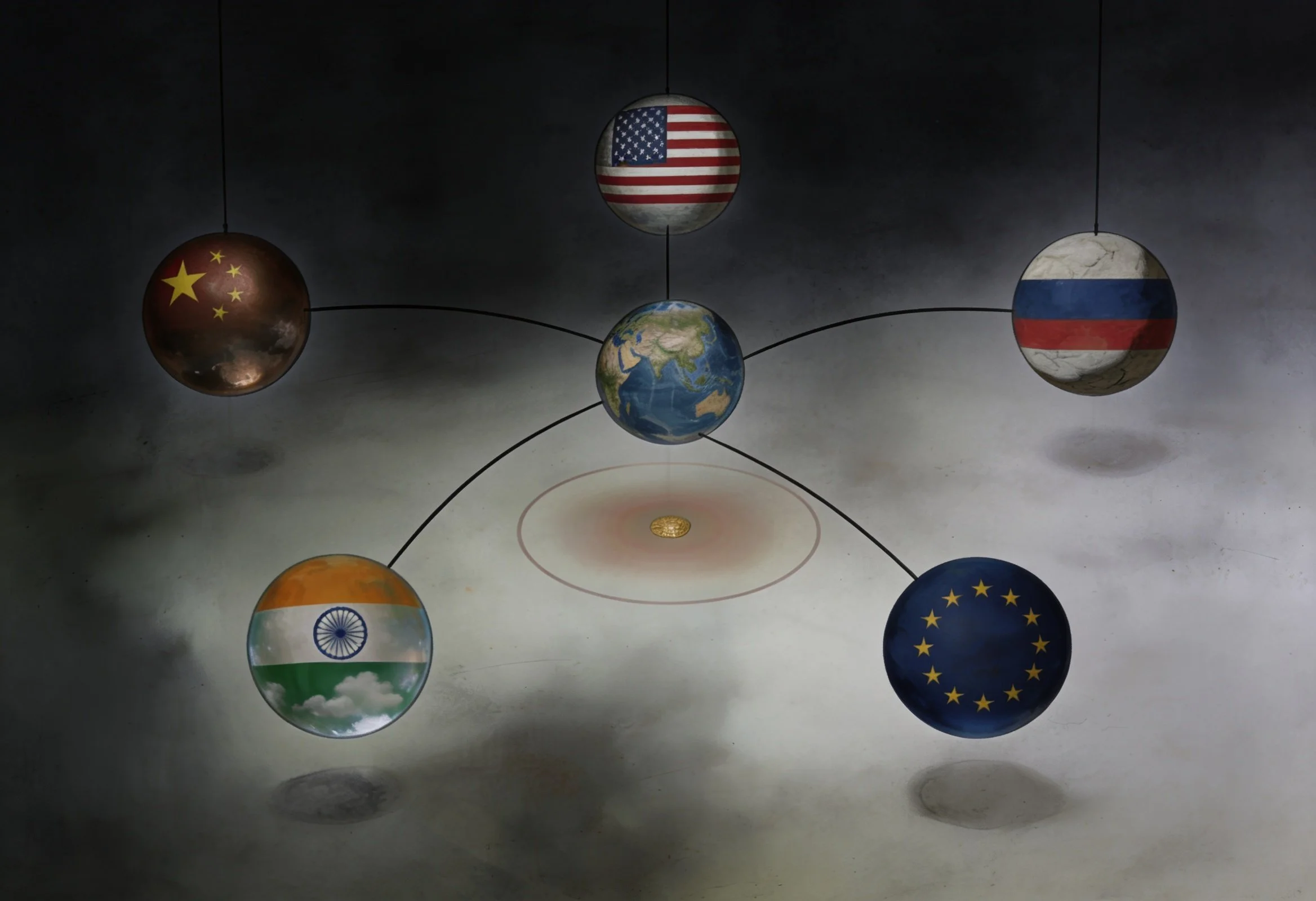
Visual generated by AI for illustrative purposes.
Key Takeaways
Shifting Global Order: The post-WWII international framework faces severe strain as unipolarity gives way to an increasingly complex, multipolar world with power dispersed among diverse global actors.
Transition and Diversity: Today's transitional era is defined by rapid technological disruption, diverse political governance systems, and states prioritizing national interests over pure ideological alignment.
Concept of "Political Gravity": Similar to physical laws keeping planets in orbit, global stability relies on "political gravity"—shared norms, institutions, and mutual restraints that prevent power competition from devolving into chaos.
Governing Multipolarity: Drawing inspiration from federal democracies balancing unity with diversity, the key 21st-century challenge is fostering a stable equilibrium between competition and cooperation without relying on a single hegemon.
Estimated Reading Time: 5 minutes
The international order established after the Second World War is under unprecedented strain. Wars in Europe and the Middle East, intensifying rivalry among major powers, rapid technological disruption, and the diffusion of global influence are reshaping international politics faster than existing institutions can adapt. The rules that helped maintain relative stability for decades no longer command universal authority, yet no coherent alternative has emerged to replace them.
Humanity has entered an era of strategic uncertainty.
This should not be mistaken for the collapse of the international system. Rather, it reflects a period of transition in which an old order is gradually losing legitimacy while a new one is still struggling to take shape. History suggests that such moments are neither exceptional nor permanent. They are the difficult but necessary stages through which new political orders are born.
The modern international system itself emerged from such a transition. After the devastation of the Second World War, states established the United Nations and gradually built what became known as the rules-based international order. Although imperfect, this framework reduced the likelihood of direct confrontation among major powers, expanded international trade, strengthened multilateral cooperation, and provided a common legal and diplomatic foundation for managing disputes.
For nearly half a century, that order was shaped by the geopolitical realities of the Cold War. The United States and the Soviet Union anchored a bipolar system in which NATO and the Warsaw Pact represented competing military, political, and ideological blocs. Following the collapse of the Soviet Union, the international system entered what many scholars described as a unipolar moment, with the United States exercising unparalleled global influence.
That moment is now fading.
China has emerged as a major global power with growing economic, technological, and military capabilities. India continues to expand its strategic influence. The European Union remains a significant political and economic actor, while regional powers across Asia, Africa, Latin America, and the Middle East increasingly pursue independent foreign policies. International politics is no longer defined by a single centre of power but by multiple actors with competing interests, different political systems, and diverse visions of global governance.
The result is an increasingly multipolar world.
This transformation is driven not only by shifts in military power but also by technological innovation, economic interdependence, demographic change, artificial intelligence, cyber capabilities, and the globalisation of finance and information. Power itself has become more dispersed than at any point in modern history.
Equally diverse are the political systems through which states govern themselves. Constitutional monarchies, parliamentary democracies, presidential republics, federal democracies, authoritarian regimes, military governments, and one-party states coexist within the same international system. Despite their institutional differences, they all pursue similar objectives: security, prosperity, political legitimacy, and national resilience.
To advance these goals, states increasingly organise themselves into broader political and economic frameworks. Some choose deep political integration, while others prefer strategic partnerships, regional organisations, trade agreements, or security alliances. The European Union remains one of the most successful examples of voluntary political integration, demonstrating that sovereignty and cooperation need not be mutually exclusive. Across the Indo-Pacific, Africa, and the Americas, new regional arrangements continue to reshape the global balance of influence.
Cooperation, however, is only one dimension of today's international landscape.
Competition has become equally defining. Major powers build networks of alliances, expand strategic partnerships, compete over technology, and seek influence across every region of the world. Even governments that publicly champion democracy, human rights, and international law have, at times, supported authoritarian partners when doing so served broader strategic interests. Such contradictions are not anomalies; they reflect one of the enduring realities of international politics. States rarely act on values alone. National interests remain the primary currency of foreign policy.
This complexity explains why today's international environment often appears increasingly fragmented. The challenge is no longer simply balancing power among states. It is managing an international system in which governments, multinational corporations, financial institutions, technology companies, and non-state actors all shape global affairs simultaneously.
The defining question of our time is therefore not who will become the next global hegemon. It is whether the emerging multipolar world can develop a new form of political equilibrium capable of preserving stability without sacrificing diversity.
To answer that question, it may be useful to look beyond politics itself—and toward the laws that govern the universe.
Every planet rotates on its own axis and follows its own orbit. Yet no planet exists in complete isolation. The stability of the solar system depends not on the dominance of a single celestial body but on an invisible network of gravitational forces that keeps each planet in dynamic balance with the others. Every planet retains its individuality while remaining part of a larger system governed by shared physical laws.
If that gravitational balance were fundamentally disrupted, instability would follow. Orbits would become unpredictable, collisions would become more likely, and the integrity of the entire system would be placed at risk.
Human societies are not governed by the laws of physics. Yet the political systems they create often depend on a remarkably similar principle.
No democracy can remain healthy if power is concentrated indefinitely in one individual, one institution, or one political force. Democratic stability emerges through balance: between government and opposition, national and local institutions, majority rule and minority rights, freedom and responsibility. Accountability, participation, the rule of law, and constitutional restraint function as the political equivalent of gravity, preventing power from drifting toward domination while holding society together.
Federal democracy offers one of humanity's most successful political models for managing this balance.
Its central purpose is not simply to divide authority between different levels of government. Rather, it seeks to reconcile two objectives that often appear contradictory: unity and diversity. States, provinces, regions, or constituent units retain meaningful autonomy to govern their own affairs, preserve their identities, and respond to local needs. At the same time, they remain bound together by common constitutional principles, shared institutions, and collective responsibility for the stability of the union.
The strength of a federal democracy, therefore, lies not in decentralisation alone but in its ability to transform diversity into cohesion. Autonomy is balanced by cooperation. Self-government is balanced by shared responsibility. Political differences become sources of resilience rather than fragmentation.
This principle extends well beyond domestic governance.
A stable multipolar international order cannot be sustained by military superiority alone, nor by economic coercion or technological dominance. History repeatedly demonstrates that durable international systems are built upon legitimacy as much as power. They endure because states accept shared rules, recognise mutual constraints, and acknowledge that their long-term security is interconnected.
In that sense, international politics also requires a form of political gravity.
Political gravity is not the concentration of power in a single hegemon. Nor does it imply rigid equality among states. Instead, it describes the shared norms, institutions, responsibilities, and mutual restraints that prevent competition from descending into permanent confrontation. Like gravity in the physical universe, it is largely invisible, yet its presence determines whether a system remains stable or begins to fragment.
Without such political gravity, multipolarity risks becoming little more than unmanaged rivalry. Regional conflicts become proxy wars. Economic interdependence becomes economic coercion. Technological innovation becomes an arena for strategic competition rather than shared progress. The absence of common political attraction allows geopolitical fragmentation to accelerate.
Conversely, a multipolar world supported by political gravity can preserve diversity without sacrificing stability. Different civilisations, political systems, and regional organisations need not become obstacles to coexistence. They can instead function as independent centres of influence connected by common principles of sovereignty, peaceful coexistence, international law, responsible statecraft, and mutual respect.
This is not an argument for uniformity. It is an argument for equilibrium.
History suggests that every enduring political order has ultimately depended upon a balance between competition and cooperation. Excessive centralisation breeds resistance. Unlimited fragmentation produces instability. Sustainable order emerges somewhere between these two extremes.
The twenty-first century will almost certainly not return to the unipolar moment that followed the Cold War. Nor is it likely to recreate the bipolar structure that defined much of the twentieth century. The future will almost certainly be multipolar. The real challenge, therefore, is not how to prevent multipolarity but how to govern it responsibly.
The defining question of our age is no longer which nation will lead the world. It is whether humanity can develop sufficient political gravity to ensure that multiple centres of power coexist without allowing rivalry to overwhelm cooperation.
Just as the universe does not depend upon the success of a single planet, humanity's future cannot depend upon the permanent dominance of any single state, alliance, or ideology. It will depend upon our collective capacity to build institutions that encourage responsibility alongside sovereignty, cooperation alongside competition, and diversity alongside unity.
Political gravity alone cannot eliminate conflict. But without it, no international order—however powerful—can remain stable for long.
The search for that new political gravity may prove to be one of the defining political tasks of the twenty-first century.
Edward Johns is a journalist and a former democracy activist. He writes on political affairs, democracy, geopolitics, and international relations.
