
Why Foreign Handshakes Cannot Save Myanmar’s Beleaguered Regime
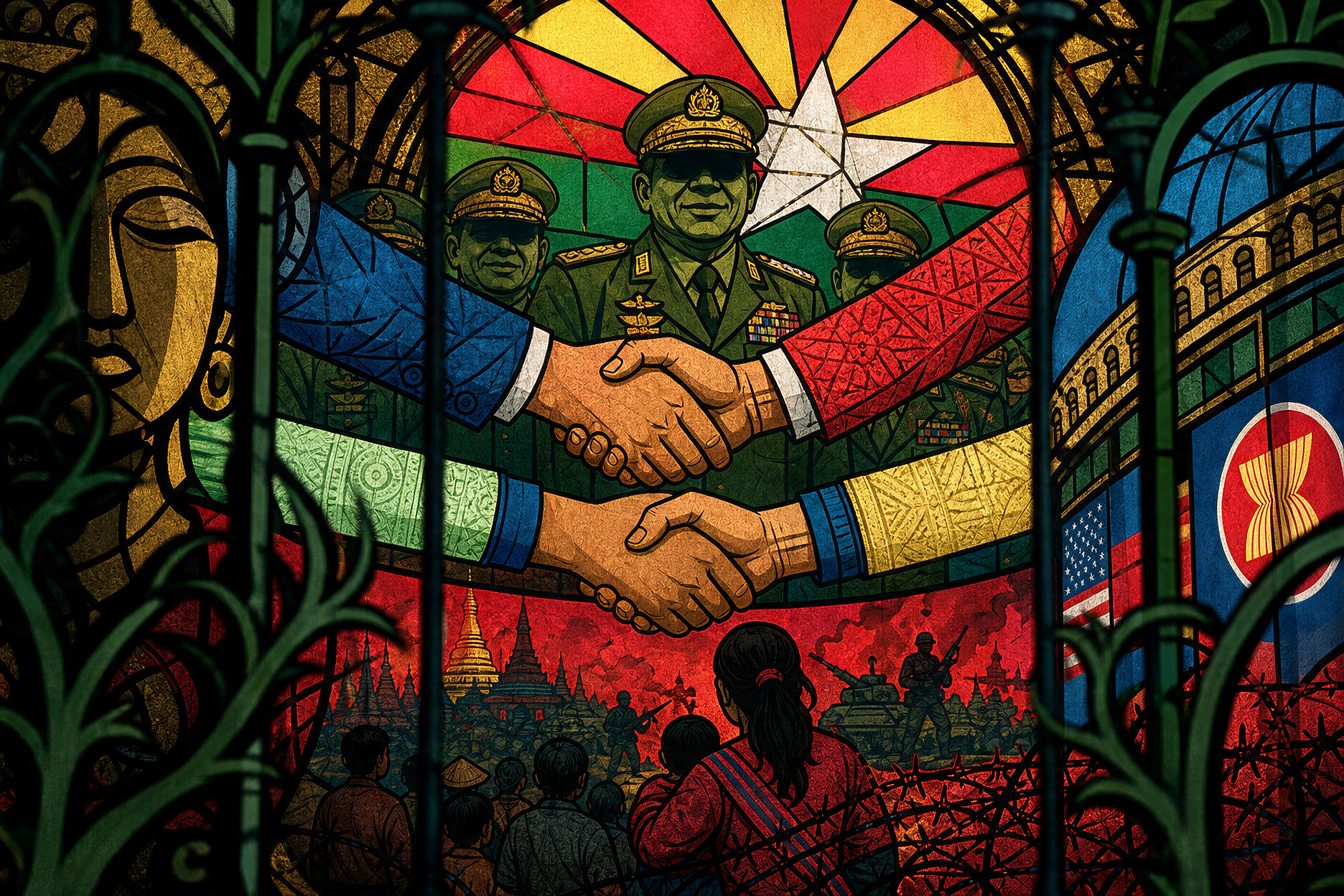
Visual generated by AI for illustrative purposes.
Key Takeaways
Optics vs Acceptance: Diplomatic engagements reflect pragmatic risk management by neighbours handling border crime and refugee spillovers, not normative endorsement of the regime.
Institutional Rejection: Staged elections and manufactured presidential titles have failed to secure credibility, highlighted by the IPU upholding the CRPH and the UN credentials deadlock.
Transactional Limits: U.S. outreach regarding rare earths and scam centres is narrow and transactional, targeting assets and borderlands the junta does not securely control.
Internal Collapse: Severe workforce deficits, forced conscription failures, currency freefall, and patron frictions with Beijing reveal a crumbling domestic apparatus that foreign handshakes cannot save.
Estimated Reading Time: ~ 5-6 minutes
Frequent overseas travels by pseudo-president Min Aung Hlaing have stirred understandable anxiety among Myanmar’s democratic forces. Beyond his high-profile visit to Malaysia, official trips across China, Russia, Belarus, India, and continental Southeast Asian capitals have been aggressively amplified by junta propaganda mouthpieces. The regime presents these optics as undeniable proof that it is clawing back international respectability. Coupled with reports of forthcoming invitations from Indonesia and Brunei, persistent speculation that ASEAN may readmit Min Aung Hlaing to its leaders' summits, and the U.S. administration’s calculated decision to re-engage with Naypyidaw, some fear the generals are breaking out of diplomatic isolation.
To fabricate an illusion of normalisation, the State Administration Council (SAC) first staged a transition into a civilian-disguised regime, with Min Aung Hlaing shedding his military uniform to assume the title of "president." Yet equating cosmetic constitutional theatre and self-interested bilateral visits with political survival is a profound analytical mistake. Democratic forces—anchored by the National Unity Government (NUG), the Committee Representing Pyidaungsu Hluttaw (CRPH), and the Steering Council for the Emergence of a Federal Democratic Union (SCEF)—have no reason to despair. Behind red carpets and polite communiqués lies an inescapable reality: the sham president is struggling to steer an unravelling war machine, an economy in freefall, and comprehensive, unyielding public resistance.
The regime’s diplomatic breakthroughs are far more cosmetic than substantive. When regional leaders sit down with Min Aung Hlaing, they are not granting legitimacy; they are scrambling to contain cross-border fallout. With Myanmar destabilising further under junta misrule, neighbouring capitals are desperate to mitigate immediate threats: industrial-scale cyber-scam cartels, illicit narcotics pipelines, paralysed border trade routes, and mounting refugee flows. Pragmatic damage control is not diplomatic acceptance.
This dynamic also underpins Washington's calculated shift. The U.S. administration’s move to establish direct communications with the regime is rooted strictly in narrow, transactional objectives: securing affordable access to critical rare earth minerals, combating illicit narcotics affecting American communities, and dismantling multibillion-dollar cyber-scam operations. This engagement is neither an ideological embrace of the rebranded junta nor an endorsement of Min Aung Hlaing as Myanmar's legitimate president. It is transactional diplomacy focused on resource security and mitigating transnational crime.
Critically, the very assets and problems Washington seeks to address lie outside the regime's control. Myanmar’s major heavy rare earth deposits are concentrated primarily in Kachin State and areas controlled or contested by Ethnic Revolutionary Organisations (EROs)—not the military. Likewise, notorious scam compounds thrive in lawless border corridors where Naypyidaw’s authority has either collapsed entirely or colludes directly with transnational syndicates. Placing faith in a pseudo-president who cannot guarantee domestic stability or enforce the rule of law will quickly prove futile for the United States.
Furthermore, doors to major multilateral institutions remain firmly shut against the regime. Within ASEAN, whether to readmit Min Aung Hlaing remains fiercely debated. Even members leaning toward accommodation hesitate to discard the bloc’s own Five-Point Consensus openly.
At the United Nations General Assembly in New York, the Credentials Committee continues to reject the regime’s nominees, ensuring Ambassador Kyaw Moe Tun remains there as a recognised representative of Myanmar's people.
Across the Atlantic, the European Union remains staunchly opposed, dismissing any cosmetic political transition that sidelines democratic leaders while tightening sanctions on aviation fuel and military revenue streams. In The Hague, the shadow of genocide proceedings at the International Court of Justice (ICJ) and looming warrants from the International Criminal Court (ICC) ensure junta leaders remain cemented as global pariahs.
A decisive contest over institutional legitimacy recently took place within the Inter-Parliamentary Union (IPU). The civilian-masked regime had hoped to slip its puppet delegates into the world’s oldest multilateral parliamentary body. Instead, the IPU resolved to retain the CRPH as an associate partner, explicitly shutting out the regime’s fabricated legislature. This decision established an enduring precedent: parliamentary legitimacy cannot be seized simply by occupying a capital city at gunpoint. The IPU affirmed that genuine authority flows from the sovereign will expressed by voters in the credible 2020 elections. Self-appointed presidential titles and martial decrees cannot manufacture constitutional validity out of thin air.
Abroad, diplomatic protocol means nothing when a military cannot hold ground at home. Inside Myanmar, the junta is losing an unwinnable civil war. Since the launch of Operation 1027 and nationwide coordinated offensives, resistance forces have captured vital border gates, overrun regional command headquarters, and severed crucial logistics arteries. An army once viewed as invincible is now trapped in defensive urban outposts and the central dry zone, relying almost entirely on terror-bombing from the skies and indiscriminate artillery fire.
Frontline battalions face unprecedented attrition. Surrenders of entire battalions, mass defections, and combat casualties have emptied the barracks. Even the desperate enforcement of forced conscription has backfired, triggering draft evasion, youth exodus, and civil resistance. Most recruits the military rounds up lack proper training and the will to fight, turning them into operational liabilities. Unlike previous military dictatorships, Min Aung Hlaing cannot effectively govern the country; across ethnic and Bamar heartlands alike, the populace views his civilian-masked regime as an occupying enemy force.
An army cannot survive without money, but Naypyidaw’s financial foundations are turning to ash. The Myanmar kyat has depreciated catastrophically, unleashing severe inflation across staple foods, fuel, and vital medicines. The regime responded with draconian currency controls, arbitrary import bans, and aggressive banking crackdowns—measures that suffocated the private sector and prompted foreign companies to freeze investments. A mass exodus of professionals, entrepreneurs, and skilled labourers ensures long-term stagnation even within areas the regime nominally controls.
Strategic ties with its primary external patron, China, are also fracturing. Relations between Beijing and the regime are riddled with deep suspicion. Pro-junta loyalists and ultra-nationalist monks who staged anti-China rallies in Yangon and Mandalay—accusing Beijing of backing northern ethnic resistance forces—have now expanded their anti-China campaigns online. Meanwhile, Min Aung Hlaing’s move to court Moscow by offering deep-water port concessions around the stalled Dawei Special Economic Zone directly conflicts with China’s ambitions for the China-Myanmar Economic Corridor (CMEC) to access the Indian Ocean. Playing Moscow off Beijing has created hazardous diplomatic friction between Naypyidaw’s two most important external backers.
For the democratic resistance, the path ahead requires strategic clarity, not defeatism. Forces must seize on the IPU precedent to systematically dismantle the regime’s pseudo-civilian presidency narrative across international forums. On the ground, the NUG and allied EROs must prove their governing capacity by consolidating transparent judicial, educational, and healthcare systems across liberated areas. Demonstrating that federal administration works on the ground renders the junta's claims of sovereignty completely hollow. At the same time, democratic forces must engage the U.S., ASEAN, and regional neighbours directly, proving that resistance institutions are the only viable, trustworthy partners capable of regulating critical natural resources and eliminating scam hubs.
History shows that embattled dictators routinely fabricate civilian transitions and stage international tours precisely when their domestic foundations are crumbling. Min Aung Hlaing travels abroad and calls himself president only to disguise his inability to govern securely at home. Courteous foreign handshakes and a new title cannot replenish shattered battalions, refill an exhausted treasury, or win over a public that utterly rejects military rule.
The true centre of gravity remains where it has always been: in the Myanmar people's unbroken resolve, their shared determination to build a federal democratic union, and their refusal to surrender the fight for freedom.
