
The Arsonist as Firefighter: Why US Cooperation with the Myanmar Regime on Cyberscams is a Historical Trap
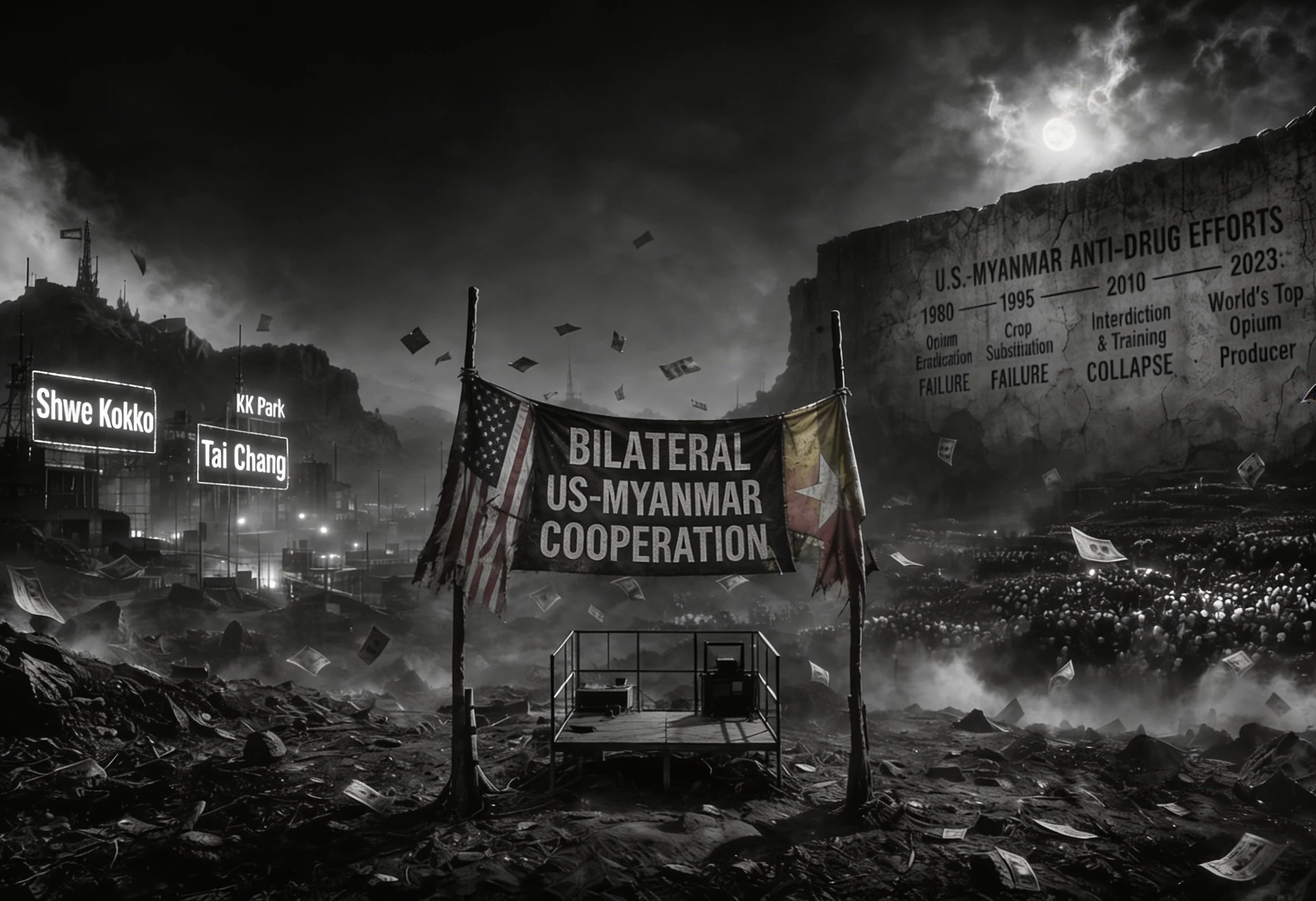
Visual generated by AI for illustrative purposes.
Key Takeaways
US Junta Talks: U.S. officials met with Myanmar’s illegal military regime to discuss law enforcement cooperation against Southeast Asian cyberscam centres, which stole $12.5 billion from Americans last year.
A Historical Mistake: Analysts warn this mirrors 1970s–1980s anti-opium efforts, where U.S. aid was used to oppress minorities, legitimising drug warlords without stopping narcotics.
Symbiotic Relationship: Cyberscam hubs operate under pro-junta militias, generating vital foreign currency for the regime; public raids are merely staged for publicity.
A Strategic Trap: Cooperating grants the regime unwarranted global legitimacy and provides it with tools to target democratic resistance.
The Solution: The U.S. must avoid the junta and partner with local civil society and democratic resistance forces.
Estimated Reading Time: 3 to 4 minutes
In late June 2026, U.S. Assistant Secretary of State Michael DeSombre testified before the House Foreign Affairs Committee, painting a grim picture of a national security threat: Southeast Asian cyberscam centres, which drained more than $12.5 billion from Americans last year alone. But it wasn’t the statistics that sent shockwaves through the community of Myanmar analysts and human rights advocates; it was the revelation that U.S. officials had quietly met with representatives of the illegal Myanmar military junta in Tokyo to discuss potential law enforcement cooperation.
To those who study the region, the U.S. government’s contemplation of working with Senior General Min Aung Hlaing’s regime to "eradicate" these digital slave-labor camps triggers a profound sense of déjà vu. It is a dangerous re-running of a failed historical script. Decades ago, Washington fell into the exact same trap, partnering with successive Burmese military rulers to eradicate opium production.
The results of that previous cooperation are a matter of historical record: millions of U.S. taxpayer dollars wasted, a military regime granted unearned international legitimacy, and drug warlords elevated to "national leaders," while Myanmar remained one of the world's largest narcotics exporters. To repeat this strategy with cyber-fraud is not just blind; it ignores the fundamental truth that the Myanmar military is not a victim of transnational crime—it is its primary beneficiary.
The Opium Precedent: Funding the Cartel to Fight the Crop
To understand why analysts are reacting with such alarm today, one must look back to the 1970s and 1980s. Terrified by the flood of heroin into American cities from the Golden Triangle, the U.S. government entered into anti-narcotics agreements with Ne Win’s military regime. Washington provided the Myanmar military with helicopters, aeroplanes, and chemical defoliants intended to destroy poppy fields.
Instead, the military redirected these U.S.-supplied assets to wage counterinsurgency warfare against ethnic minority groups fighting for autonomy. The poppy fields kept blooming. Worse still, the military regime cut deals with notorious drug lords like Khun Sa and Lo Hsing-han, offering them state protection and business monopolies in exchange for fighting anti-regime rebels.
The U.S. anti-drug money essentially subsidised a system where warlords were sanitised into "national leaders" and legitimate tycoons, driving the country's formal economy while their private militias operated under the junta's umbrella. The U.S. got nothing but empty promises, while the regime got a blank check and political survival.
The Myth of the Junta’s "Zero Tolerance"
Today, the commodity has changed from opium to human souls and digital theft, but the mechanics remain identical. Cyberscam hubs like the notorious KK Park and Shwe Kokko operate under a symbiotic relationship with the junta. They are physically guarded and managed by groups like the Karen National Army (KNA, formerly the Border Guard Force), a militia explicitly aligned with and protected by the military regime.
The U.S. Treasury itself has acknowledged this, sanctioning KNA leader Saw Chit Thu for generating billions in scam revenue while acting under the junta’s wing. The scam compounds provide the cash-strapped, internationally isolated military regime with vital foreign currency to purchase weapons and fuel its brutal campaign against its own citizens.
When under heavy international pressure—particularly from China—the junta occasionally stages highly publicised raids, such as the "demolition" of parts of KK Park late last year. State-run television broadcasts footage of soldiers standing triumphantly over seized Starlink terminals. But satellite imagery and intelligence from organisations like the International Justice Mission tell a completely different story. As soon as the cameras turn off, the operations simply move a few miles down the road into newly built compounds like Hpakalu, running smoothly under the watchful eye of pro-regime militias.
As Myra Dahgaypaw of the U.S. Campaign for Burma aptly summarised the current dilemma: "Cooperation with Min Aung Hlaing's regime would mean helping the very same criminal enterprise that is responsible for... these scam centres. It is like asking an arsonist to help put out a fire."
Laundering Legitimacy
The greatest danger of the U.S. government exploring "all options" for law enforcement cooperation is not merely the financial cost; it is the currency of political legitimacy. Since the 2021 coup, the military junta has fought a losing battle for domestic control and international recognition. By sitting across the table from junta generals to map out police cooperation, Washington inadvertently hands the regime the ultimate prize: status as a recognised, necessary state actor on the global stage.
If history is any guide, the junta will use U.S. intelligence and tactical cooperation not to dismantle the multi-billion dollar scam industry, but to target the real democratic opposition. Meanwhile, the actual architectural brains behind the scam networks—the transnational organised crime syndicates and state-aligned warlords—will once again be insulated, adapting their businesses while laughing all the way to the bank.
A Better Way Forward
If the United States genuinely wishes to protect its citizens from digital plunder and rescue the hundreds of thousands of people trafficked into these modern-day slave compounds, it must stop looking to Naypyidaw for answers.
The only entities that have demonstrated a genuine will to dismantle these networks are local civil society organisations and elements of the democratic resistance movement. In December 2025, it was the Karen National Union (KNU)—an ethnic resistance organisation firmly opposed to the junta—that successfully raided the Shunda Park scam compound, freeing thousands of enslaved workers.
Washington must heed the chorus of over two dozen NGOs that have called for an immediate halt to any law enforcement engagement with the junta. The U.S. must instead leverage its Scam Centre Strike Force to work alongside regional allies, civil society, and democratic resistance forces who are actually committed to the rule of law.
Decades ago, Washington’s naivety turned Myanmar's opium warlords into kings. If the U.S. falls for the junta’s trap once again, it will succeed only in cementing a new generation of cyber-militia billionaires, leaving American taxpayers to foot the bill for their own deception.
A. K. Barua is a journalist and analyst specialising in Myanmar.
