
Cornered in Naypyidaw
Why Min Aung Hlaing’s Ultimatum to ASEAN Signals Defeat, Not Strength

Visual generated by AI for illustrative purposes.
Key Takeaways
Diplomatic Blockade: Despite orchestrating sham elections and assuming the presidency, Min Aung Hlaing failed to break ASEAN’s consensus after firm vetoes from Malaysia and Singapore.
Hostile Pivot: In response to continued exclusion, the regime declared ASEAN’s Special Envoy unnecessary, threatening reciprocal measures and signaling a potential exit from regional mechanisms.
Strategic Vulnerability: The junta's aggressive posturing masks battlefield losses in Shan and Rakhine states, severe economic breakdown, and complete geopolitical reliance on Beijing and Moscow.
Principled Stance: ASEAN’s refusal to recognise manufactured elections proves that true normalisation depends entirely on ending military rule.
Five years after launching a disastrous military coup that plunged Myanmar into an unrelenting civil war, Senior General Min Aung Hlaing finds himself in an unprecedented diplomatic blind alley. Having orchestrated a staged "election" to install a nominally civilian government with himself as President, the junta chief envisioned a smooth return to the international fold. Instead, his grand political theatre has collapsed against the unyielding wall of Southeast Asian diplomacy.
The junta’s recent strategy was as ambitious as it was cynical. By trading military fatigues for presidential suits, Naypyidaw sought to weaponise a “civilian” facade to fracture the Association of Southeast Asian Nations (ASEAN). Aided by neighbouring Thailand and a handful of like-minded regional partners favouring pragmatic re-engagement, the regime launched an aggressive lobbying push. Their argument was simple: the 2021 coup era was over, an “elected government” was in place, and ASEAN’s five-year ban on top-level junta participation should be quietly discarded.
Yet this elaborate charade crumbled when it met the principled resistance of ASEAN’s core guardians. Led by Malaysia and Singapore, key member states refused to swallow the bait. They recognised that a self-managed election conducted amid widespread violence, political detentions, and structural coercion confers zero legitimacy. Changing official titles does not erase the origin of a regime that destabilises the entire region through conflict, refugee crises, and transnational crime enclaves. ASEAN’s Five-Point Consensus (5PC) remained intact, and Naypyidaw’s path to full representation was firmly blocked.
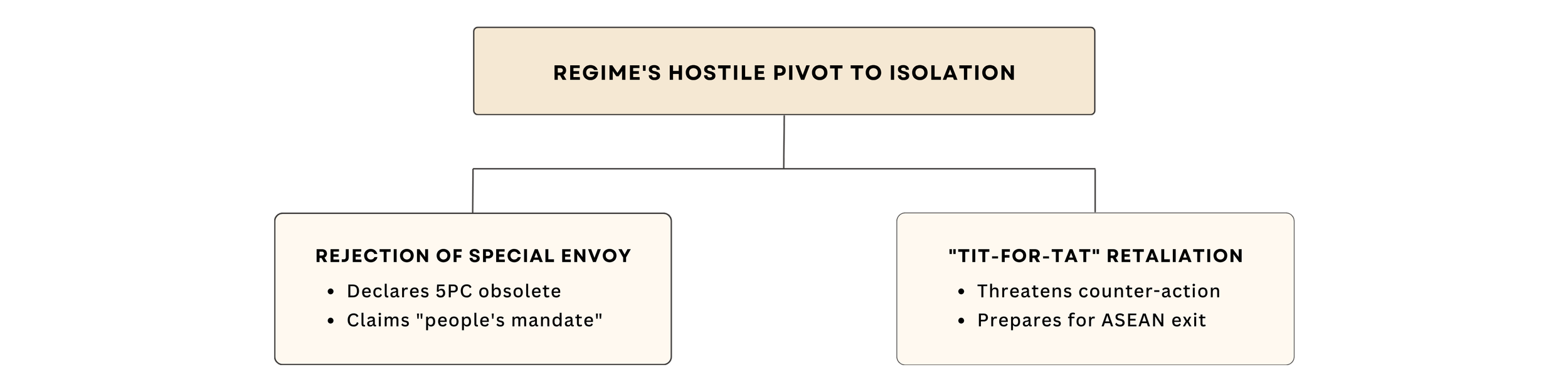
Facing an embarrassing diplomatic veto, Min Aung Hlaing’s response was swift, hostile, and telling. In a defiant public address, the self-appointed President declared that ASEAN no longer requires a Special Envoy on Myanmar. Claiming that his administration was “elected by the people,” he warned that Naypyidaw would respond in a “tit-for-tat” manner to any continued interference in its internal affairs.
This rhetoric is not a display of power—it is the desperate reaction of a cornered actor. Having exhausted his political and military playbooks, Min Aung Hlaing’s options are evaporating. On the battlefields across the country, resistance forces retain tactical momentum. Domestically, the regime’s economy is in freefall. Internationally, failing to break ASEAN's consensus leaves the junta almost entirely dependent on Beijing and Moscow, stripping Naypyidaw of any strategic autonomy.
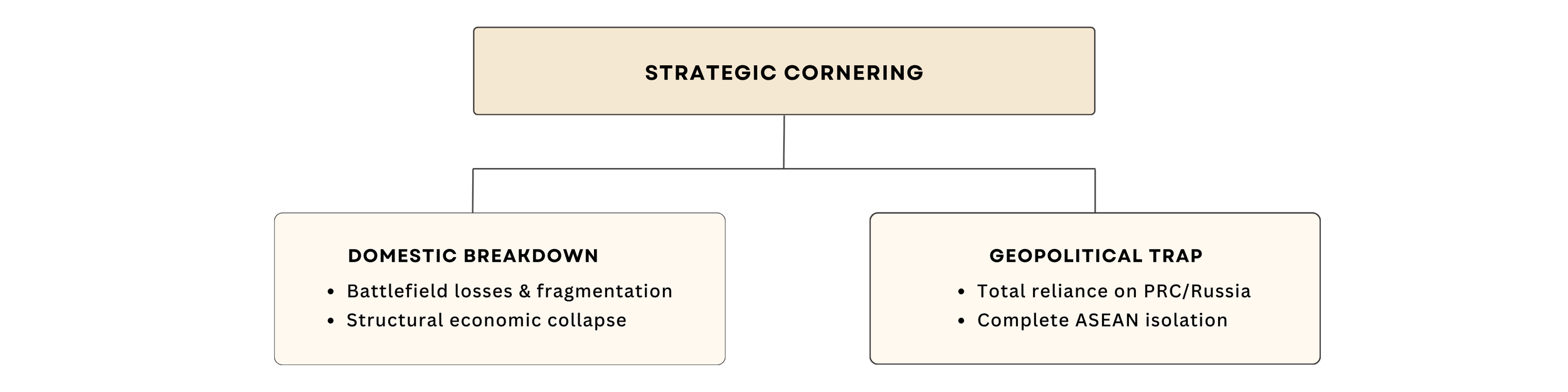
When a ruler threatens retaliatory measures against the very regional bloc he spent years trying to rejoin, it signals that his diplomatic strategy has completely failed. Min Aung Hlaing’s threat to abandon ASEAN mechanisms proves that the bloc’s refusal to compromise was the correct course.
ASEAN, Malaysia, and Singapore must not back down. By holding the line on the Five-Point Consensus, Southeast Asia has shown that manufactured elections cannot buy international legitimacy. As Naypyidaw prepares to retreat into deeper self-imposed isolation, the regional body must double down on its stance: true normalisation can only begin when military rule ends, and the genuine will of Myanmar's people is restored.
A. K. Barua is a journalist and analyst specialising in Myanmar.
