
Illusion of Legitimacy: Why Min Aung Hlaing’s Diplomatic Gambits Will Fail at the UN
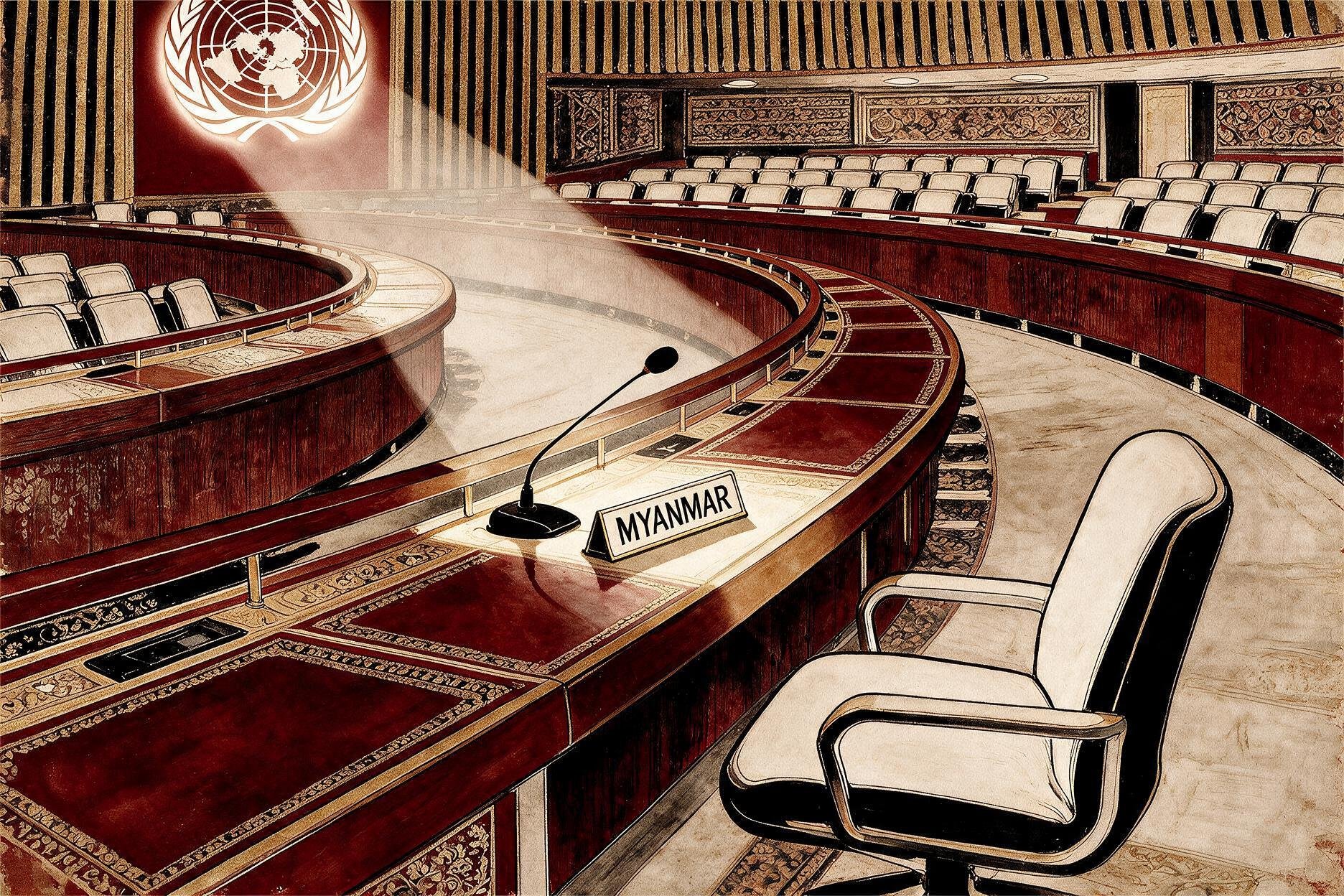
Visual generated by AI for illustrative purposes.
Executive Summary
Following Myanmar’s February 2021 coup, a dominant narrative quickly took hold among international policymakers—particularly Western officials and global analysts—that Min Aung Hlaing had cast himself into diplomatic exile. Shut out of ASEAN’s highest‑level summits and encircled by sweeping Western sanctions, the junta was widely portrayed as a regime drifting into diplomatic irrelevance.
Yet, Naypyidaw is executing an aggressive, multi-track hedging strategy designed to project an illusion of international normalisation. From receiving official honours in Moscow, Bangkok, Beijing, and New Delhi to securing Shanghai Cooperation Organisation (SCO) Dialogue Partner status, co-initiating "Eurasian Charter" security talks, and preparing for the rotation of the Bay of Bengal Initiative for Multi-Sectoral Technical and Economic Cooperation (BIMSTEC) chairmanship, the regime is cultivating an alternative network of multipolar ties. Flanked by UN Security Council veto-holders Russia and China, junta strategists believe their ultimate diplomatic objective is now within reach: displacing democratic Ambassador U Kyaw Moe Tun and reclaiming Myanmar’s seat at the United Nations in New York.
However, this optimism rests on a fundamental misreading of international law, the mechanics of the UN Credentials Committee, and the strategic limits of realpolitik. Transactional survival abroad cannot substitute for sovereign legitimacy at home.
Estimated Reading Time: 6 minutes
1. The Mirage of Isolation: Naypyidaw's Parallel Multilateralism
To understand Naypyidaw's growing confidence, one must analyse how the regime has systematically exploited emerging global fault lines. Blocked from formal ASEAN summits, Min Aung Hlaing has bypassed traditional diplomatic channels by embedding Myanmar within an explicitly revisionist, anti-Western alignment.
The Eurasian Security Axis: The regime has deepened bilateral military, energy, and economic ties with Russia, Belarus, Iran, and North Korea. This includes civil nuclear energy cooperation with Russia’s Rosatom and consultative participation in the proposed Eurasian Charter of Diversity and Multipolarity in the 21st Century.
Sub-Regional Platforms: In May 2023, Myanmar officially became a Dialogue Partner of the Shanghai Cooperation Organisation (SCO). Simultaneously, the regime utilises its membership in BIMSTEC—a technical body devoid of human rights conditionality—to showcase regional integration, culminating in its upcoming turn as organisational chair.
Bilateral Pragmatism: Immediate neighbours like Thailand, India, and China continue to maintain active functional relationships with the regime. Driven by immediate concerns over border security, refugees, transborder online scam compounds, and strategic transport corridors, these states engage Naypyidaw out of geographical necessity rather than normative endorsement.
The regime’s overarching strategy relies on a process of "electoral laundering." Following controlled elections, the military leadership intends to transition Min Aung Hlaing into the role of a nominally "civilian" President. The junta’s calculation is clear: present regional partners with an administrative facade to lower the political cost of formal re-engagement, then leverage that momentum to demand recognition on the world stage.
2. The UN Credentials Trap: Lessons from History
The belief that the SAC can leverage its alternative alignments to win Myanmar’s UN seat in New York ignores both structural precedents and UN Credentials Committee procedures.
The nine-member UN Credentials Committee—which traditionally includes the United States, China, and Russia alongside six rotating member states—does not evaluate competing claims simply by asking who occupies the primary government offices in a capital. Historically, the committee’s handling of contested representation reveals three distinct legal and procedural models that counter Naypyidaw's ambitions:
A. The "Indefinite Deferral" Standard (The Taliban Analogy)
When the Taliban captured Kabul in 1996—and again after their return to power in 2021—they controlled the vast majority of Afghan territory. Yet, the UN Credentials Committee repeatedly deferred formal decisions, leaving the diplomatic representatives of the ousted democratic republic in their seats. Deferral acts as an institutional deep-freeze: it deprives an illegitimate de facto authority of international recognition without forcing P5 powers into a public floor vote. For Naypyidaw, the Taliban precedent illustrates that controlling the capital does not guarantee UN accreditation.
B. The Presumption of Democratic Legitimacy (The Haiti Analogy)
Following the 1991 military coup against President Jean-Bertrand Aristide in Haiti, the UN Credentials Committee consistently upheld the credentials of Aristide’s envoys in exile. The General Assembly affirmed that a government born of a popular democratic mandate does not lose its sovereign standing simply because a military junta usurped administrative power by force. This principle directly protects Ambassador U Kyaw Moe Tun, whose authority remains anchored in the 2020 general election—the last valid expression of popular sovereignty in Myanmar.
C. Normative Exclusionary Precedents (The South Africa Analogy)
In 1974, the General Assembly took the extraordinary step of rejecting the credentials of South Africa’s apartheid delegation due to gross violations of the UN Charter and human rights norms. This established that credentials are not merely a technical registry of physical power, but a tool of normative judgment. With the SAC facing ongoing proceedings at the International Court of Justice (ICJ) and accused of widespread war crimes, the South Africa precedent highlights the severe normative barriers the junta faces in New York.
3. The Fractured ASEAN Axis and P5 Realpolitik
Crucially, Naypyidaw’s UN ambitions are further stalled by internal geopolitical divides within Southeast Asia. ASEAN is increasingly bifurcated between maritime states committed to democratic norms and mainland states prioritising pragmatic border management:
The Maritime Bloc (Indonesia, Singapore, Malaysia, Philippines): Firmly defends the Five-Point Consensus and opposes premature recognition of the SAC, arguing that legitimising coup leaders undermines regional stability and destroys ASEAN's international credibility.
The Mainland Bloc (Thailand, Laos, Cambodia): Engages in "calibrated re-engagement" to manage immediate border security, economic links, and cross-border criminal networks.
This regional split paradoxically works against the regime at the UN. For Beijing, preserving overall ASEAN Centrality and maintaining smooth relations with Southeast Asia’s largest economies is far more vital than installing a regime delegate in New York.
UN Security Council adopted Resolution 2669
This institutional deadlock is further compounded by the regime’s complete failure to comply with formal UN Security Council mandates. On December 21, 2022, the UN Security Council adopted Resolution 2669—its first landmark resolution on Myanmar since the coup. The resolution demanded an immediate cessation of violence, the release of all arbitrarily detained political prisoners (including President Win Myint and State Counsellor Aung San Suu Kyi), full and unhindered humanitarian access, and the implementation of ASEAN’s Five-Point Consensus.
Rather than fulfilling these obligations, the military junta officially rejected Resolution 2669 immediately upon its adoption and has systematically defied every requirement. Instead of de-escalating, the military expanded its campaign of indiscriminate airstrikes and shelling against civilian populations, weaponised humanitarian aid, and blocked political dialogue. Because Resolution 2669 was adopted under Chapter VI of the UN Charter (peaceful settlement of disputes) rather than Chapter VII enforcement measures, the Security Council has lacked automatic binding enforcement. However, the junta’s total non-compliance reinforces its status as an uncooperative rogue authority in the eyes of the international community.
While China and Russia provide Naypyidaw with arms, trade, and UN Security Council veto protection, neither power possesses an incentive to expend significant political capital forcing a General Assembly floor vote on Myanmar’s credentials. A push to seat the SAC would provoke an intense backlash from Western nations, the Global South, and key ASEAN capitals. Consequently, Beijing and Moscow acquiesce to the procedural compromise of deferral.
4. Conclusion: Tactical Survival vs. Sovereign Legitimacy
Min Aung Hlaing and his regime have successfully engineered a diplomatic survival strategy. By substituting ASEAN mechanisms with Eurasian partnerships, sub-regional forums like BIMSTEC, and transactional bilateral ties with immediate neighbours, the junta has averted total international isolation.
However, this strategy reaches a hard limit at the United Nations. Transactional relationships built on geographic proximity and arms procurement do not confer international legal legitimacy. Bound by established credentials precedents, the presumption of democratic mandates, and the major powers' desire to avoid explosive floor battles, the doors of the United Nations General Assembly remain closed to the regime.
Red-carpet visits to foreign capitals may offer Naypyidaw an illusion of normalisation. But as resistance forces continue to challenge the military's territorial control across Myanmar's heartland and border regions, the regime is confronted by an inescapable realpolitik reality: external diplomatic manoeuvring cannot substitute for domestic legitimacy.
Ultimately, the Myanmar military dictators—who disguise themselves as a civilian government while committing acts of violence, violating international law, and committing war crimes and crimes against humanity—must in no way be permitted representation in rule-based international organisations like the UN that uphold international standards and values. UN member states must join forces to ensure the regime is denied this platform. Just as the preamble of the UN Charter begins with "We the peoples of the United Nations," international actors must uphold the letter and spirit of the Charter to protect civilians from the horrors of war—particularly from indiscriminate aerial bombardments. To ensure these voices of the people are heard and protected, denying the military dictatorship representation at the United Nations remains an absolute necessity.
A. K. Barua is a journalist and analyst specialising in Myanmar.
