
Friction on the Andaman Coast
How Beijing Views Moscow’s Foothold in Dawei
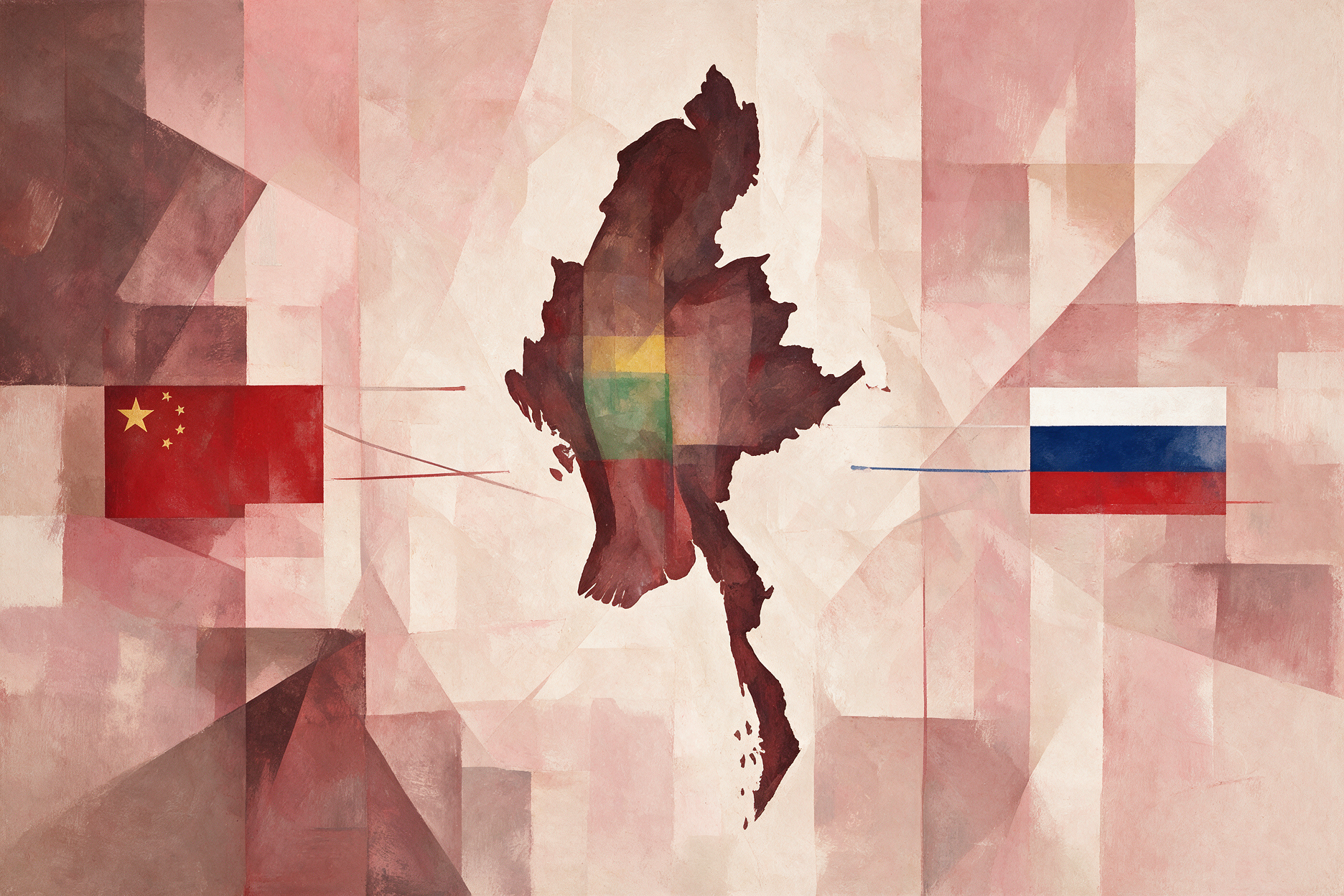
Visual generated by AI for illustrative purposes.
Key Takeaways
Limits of the Moscow–Beijing Alignment: While Russia and China project unity against the West, Russia's bid for majority ownership in the Dawei Special Economic Zone (SEZ) exposes deep transactional competition between the two powers over access to Myanmar’s coastline.
Threat to China’s Maritime & CMEC Monopoly: A Russian-controlled deep-sea port and oil refinery in Dawei presents an alternative transit corridor to Thailand and the Greater Mekong Subregion, challenging Beijing’s "Two Oceans" strategy and the exclusivity of the China-Myanmar Economic Corridor (CMEC) anchored at Kyaukpyu.
Exploiting Moscow's Structural Constraints: Rather than directly confronting Moscow, Beijing is waiting out Russia’s limited wartime liquidity and capital shortages, preparing to leverage Chinese subcontractors and potential rescue financing if the $8–$10 billion greenfield project falters.
Outsourcing the Security Burden: Beijing is content to let Russia navigate the violent conflict, active resistance, and severe logistical headaches currently engulfing Tanintharyi Region.
Calibrated Leverage on Naypyidaw: Beijing keeps the military-backed regime’s external hedging in check by controlling northern border trade flows and diplomatic leverage with ethnic resistance organisations, ensuring Naypyidaw remains dependent on China for day-to-day survival.
Estimated Reading Time: ~ 4 minutes
While Beijing and Moscow project a cohesive front against Western pressure on the global arena, the Myanmar theatre reveals the transactional limits of their partnership. After the State Administration Council (SAC) transformed into a nominally civilian administration, the military-backed leadership aggressively courted the Kremlin to balance China’s overwhelming regional leverage. At the centre of this diplomatic manoeuvring sits the long-stalled Dawei Special Economic Zone (SEZ) on the Andaman Sea, where Moscow has demanded majority ownership during the capital payback period.
For China, which regards Myanmar as its essential overland bridge to the Indian Ocean, Russia’s growing maritime and economic aspirations in Tanintharyi Region represent an unwelcome complication. Beijing’s response is unfolding across three separate dimensions: outward tolerance, quiet commercial containment, and calibrated pressure on Naypyidaw.
1. Diplomatic Utility vs Geopolitical Encroachment
At a macro level, Beijing values Moscow’s role in keeping the regime economically and militarily functional. Russian arms supplies, diplomatic vetoes at the United Nations, and oil shipments provide Naypyidaw with resources that China prefers not to supply entirely on its own, mitigating direct Western blowback on Beijing.
However, this tactical tolerance stops at the coastline. Myanmar’s coast is central to China’s Two Oceans strategy, which aims to circumvent the vulnerable Malacca Strait. While China previously assessed the Dawei Special Economic Zone (SEZ) before concentrating its state resources on the Kyaukpyu deep-sea port in Rakhine State, Beijing never intended for Dawei to become the exclusive domain of an external power. A Russian-controlled deep-sea port and oil refinery capable of processing 100,000 barrels per day directly challenges China’s vision of dominating regional transit corridors.
2. The Threat to China’s CMEC Monopoly
Beijing views infrastructure through the lens of long-term economic integration. Under the China-Myanmar Economic Corridor (CMEC), China has invested heavily in oil and gas pipelines, cross-border road networks, and port facilities intended to pull Myanmar directly into the economic orbit of Yunnan Province.
This difference in strategic priorities is most visible when contrasting China's flagship maritime venture with Russia's proposed hub in the south. In Rakhine State, the Kyaukpyu Deep-Sea Port and SEZ is anchored by a CITIC-led Chinese consortium, designed explicitly to serve as a direct energy and freight transit artery into southwestern China while providing an overland bypass around the Malacca Strait. In contrast, the Dawei Deep-Sea Port and SEZ—where Moscow has proposed securing a majority equity stake—is regarded as a Russian maritime logistical outpost, a potential naval foothold, and an alternative trade gateway connecting the Andaman Sea directly to Thailand and the wider Greater Mekong Subregion.
If Moscow secures long-term equity and operational control over Dawei, it establishes this alternate multimodal corridor outside of Chinese state oversight. Beijing is deeply sensitive to any infrastructure that gives Naypyidaw independent, non-Chinese financing channels or alternative energy-refining capacity.
3. Exploiting Russian Capital Shortfalls
Beijing understands the organisational limitations of Moscow’s pivot. Russia’s economy is constrained by protracted wartime spending and international isolation, leaving it ill-equipped to independently finance an estimated $8 billion to $10 billion greenfield port and industrial complex.
Rather than confronting Moscow directly, China is taking a patient stance:
• Letting Moscow Absorb the Security Burden: The Tanintharyi Region is engulfed in armed conflict between regime forces and resistance groups. China is content to let Moscow navigate local instability, anti-regime resistance, and the supply chain friction of long-distance supply chains.
• Positioning for Subcontracting Leverage: If Russian state enterprises attempt construction, they will inevitably rely on Chinese equipment, logistics providers, and regional subcontractors because of supply-chain proximity.
• Readying Financial Buy-Ins: If Russian capital dries up during the initial dredging or power-generation phases, Chinese state-owned enterprises will be in a strong position to step in as indispensable financiers, turning a Russian project into a CMEC-dependent node.
4. Disciplining Naypyidaw’s Geopolitical Hedging
Beijing applies its primary leverage not against Moscow, but directly against Naypyidaw. Myanmar’s military leadership has historically used major-power competition to present domestic political manoeuvring. After the battlefield disruptions of Operation 1027, Beijing showed that it holds the keys to border trade and military equilibrium across Shan and Kachin States.
When the regime leans too far into Moscow's orbit to evade Chinese influence, Beijing can adjust customs flows, modulate enforcement at border crossings, and calibrate its diplomatic engagement with ethnic resistance organisations. These levers remind the regime that while Russian jets and port MOUs are diplomatically convenient, day-to-day economic survival remains tied to China.
The Strategic Outlook
Beijing will not openly break with Moscow over Myanmar, but it will not allow Russia to establish an unchallengeable maritime stronghold in Dawei. China will accelerate its own Kyaukpyu corridor, apply calibrated economic leverage on Naypyidaw, and exploit Russian capital shortages. For the regime in Naypyidaw, the belief that it can pit Moscow against Beijing without incurring severe costs is an illusion; in the end, it risks leaving Myanmar’s critical infrastructure vulnerable to the overlapping ambitions of both powers.
