
The Mirage on the Andaman Sea
The Hard Realities Facing Russia’s Dawei Ambitions
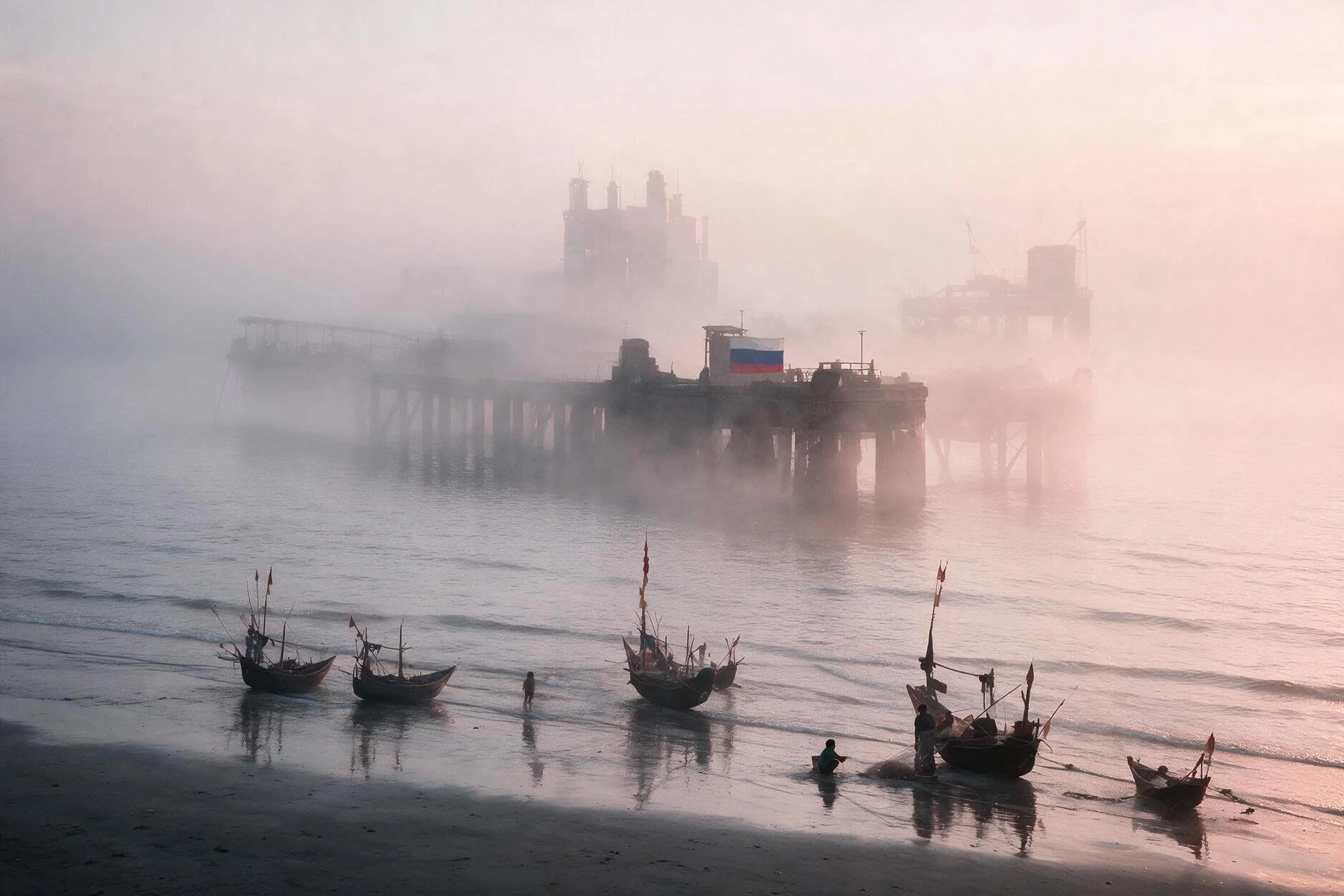
Visual generated by AI for illustrative purposes.
Key Takeaways
Escalating Security Risks: Active armed conflict across Tanintharyi Region threatens key transport corridors toward the Thai border, leaving foreign personnel and heavy construction lifelines vulnerable to interdiction by resistance forces.
Severe Financial Bottlenecks: Dual international sanctions, exclusion from SWIFT networks, and Moscow’s domestic wartime constraints severely limit the multibillion-dollar capital liquidity required for full-scale development.
Greenfield Infrastructure Deficits: The Nabule site lacks basic utilities, high-voltage grid connections, and deep-water berths, requiring immense preliminary capital before generating any commercial refining returns.
Regional Supply Chain Disconnect: Without trilateral engagement from Thailand, Japanese financing, or ASEAN manufacturing integration, a Russian-managed zone risks becoming an isolated enclave lacking viable regional off-takers.
Estimated Reading Time: 3 minutes
In its search for economic lifelines and strategic leverage beyond Beijing, Naypyidaw has turned to Moscow to revive the dormant Dawei Special Economic Zone (SEZ). The proposed blueprint is ambitious: a deep-sea port on the Andaman Sea, a 660 MW power plant, and an industrial oil refinery. During bilateral business forums, Russian Economic Development Minister Maxim Reshetnikov emphasised that securing majority ownership during the capital payback period is a core requirement for Russian banks and state-linked enterprises to commit capital.
Yet an immense gulf lies between bilateral memorandums and operational reality. The revival of Dawei under Russian management faces severe structural bottlenecks across security, financial, and logistical domains, casting doubt on the viability of the entire undertaking.
1. Active Resistance and Territorial Contestation
The most immediate barrier to developing the Dawei SEZ is the collapse of security across southern Myanmar. Unlike during earlier development phases under Thai consortia, Tanintharyi Region is now an active conflict theatre.
• Contested Transport Corridors: The planned 138-kilometre arterial highway connecting the SEZ site at Nabule to the Thai border crossing at Htee Khee / Phu Nam Ron cuts through territory actively contested by allied resistance forces, including the Karen National Liberation Army (KNLA) and local People’s Defence Forces (PDFs).
• Supply Line Interruption: Transporting heavy industrial equipment and construction materials overland requires stable corridors that the military-led administration cannot reliably secure without diverting front-line troops.
• Targeting of Foreign Infrastructure: High-profile foreign-backed infrastructure assets and technical personnel represent visible targets for anti-regime resistance. Securing work sites would require heavy military deployments, adding substantial friction and risk premiums to project execution.
2. Dual Sanctions and Capital Deficits
Transforming Nabule’s coastline into a functional deep-water commercial hub and petrochemical refining zone requires an estimated $8 billion to $10 billion. Neither partner is positioned to deploy that scale of capital under present international constraints.
The project's financial foundation is severely constrained by three interlocking bottlenecks. First, ongoing banking isolation stemming from Western sanctions has excluded both Naypyidaw and Moscow from international SWIFT clearing mechanisms, completely eliminating standard project-finance channels and multilateral lending. Second, severe capital scarcity and liquidity constraints on Russian state funds—driven by protracted wartime expenditures—restrict potential Russian investments to isolated pilot projects rather than comprehensive zone development. Finally, severe bilateral settlement imbalances and the extreme volatility of Ruble-Kyat exchange mechanisms deter secondary commercial subcontractors and equipment suppliers from accepting the regime’s payment terms.
3. Logistical Realities and Greenfield Deficits
Beyond security and finance, the project site at Nabule is fundamentally a greenfield area lacking the baseline infrastructure required for heavy industrial manufacturing:
• Utility Deficits: There is no existing high-voltage electrical grid or deep-water berth. Developing the proposed 660 MW power plant and water networks is a prerequisite for any industrial production or refining.
• Disconnection from Regional Markets: The commercial logic of Dawei historically depended on integration with Thailand’s Eastern Seaboard industrial corridor. Without trilateral backing from Bangkok, Japanese development finance, and ASEAN multilateral partners, a Russian-managed zone risks becoming an isolated outpost without immediate manufacturing off-takers.
• Long Maritime Lines: Unlike Chinese supply chains that share a contiguous land border with Myanmar, Russian machinery, refining modules, and specialised maritime equipment must traverse distant, sanction-exposed maritime shipping routes.
The Realistic Trajectory
As Russian business delegations have confirmed, Moscow’s insistence on majority equity is a mechanism to hedge against extreme commercial and geopolitical risks.
Without resolving the ground-level armed conflict in Tanintharyi, securing billions in unencumbered capital, or establishing regional integration with Thailand, the Dawei SEZ is likely to remain stalled. For Naypyidaw, ceding controlling stakes in strategic national assets to Moscow offers headline-grabbing diplomacy, but provides few realistic solutions to the severe security and economic realities on the ground.
